Quick Takeaways
- Timing is everything with flowering trees—pruning at the wrong point in the season can cost you an entire year’s worth of blooms.
- Spring-blooming trees like dogwoods, redbuds, and cherry trees should be pruned right after they finish flowering, not before.
- Summer-blooming trees like crepe myrtles and mimosas can be pruned in late winter or early spring before new growth starts.
- May is an active month for Northern Virginia tree care—some species are finishing their bloom cycle while others are pushing new growth, so species identification matters before you pick up any tool.
- Proper pruning technique protects tree health; improper cuts invite disease, pest entry, and long-term structural problems.
- Knowing when a pruning job needs a certified arborist versus a DIY approach can save you significant money and keep your trees healthier over time.
- While you focus on pruning, keep a sharp eye out for invasive hitchhikers, as protecting your Manassas landscape from the pests starting in early spring is vital to preventing these pests from weakening your trees.
There’s a window in early May when Northern Virginia is genuinely hard to beat. Dogwoods are still holding their last blooms, redbuds are winding down, the cherry trees along neighborhood streets have finished their show, and the azaleas under the oaks are doing their thing. If you’ve spent any time driving around the older neighborhoods near Old Town Manassas or through the residential pockets off Sudley Manor Drive, you’ve seen what a well-planted, well-maintained landscape looks like when it’s firing on all cylinders.
Then someone prunes their cherry tree at the wrong time of year, and the following spring it produces almost nothing.
Timing is the variable that most homeowners get wrong with flowering trees, and it’s not because they’re careless—it’s because the rules are different depending on the species, and nobody hands you a schedule when you plant a tree. May is actually a month where several of those rules converge in important ways. Some trees have just finished blooming and are in their ideal pruning window. Others are in active growth and should be left alone. Getting this right is the difference between a tree that performs beautifully year after year and one that frustrates you every spring.
This guide is written specifically for Northern Virginia conditions—the clay soils, the humid summers, the species that actually grow here—with Manassas and the surrounding communities in mind. Whether you’re managing a mature dogwood, a row of crepe myrtles along the fence line, or a Japanese cherry you inherited when you bought the house, here’s what you actually need to know.
Why Pruning Timing Matters More Than Most Homeowners Realize
Before getting into species specifics, it helps to understand the underlying biology at work—because once you do, the timing rules make intuitive sense rather than feeling arbitrary.
Flower Buds Form Earlier Than You Think
For spring-blooming trees, the flower buds that produce next year’s display don’t form in spring. They form in summer and fall of the prior year, during and after the current year’s bloom period. When you prune a spring-blooming tree in late winter or early spring—before it flowers—you’re cutting off buds that were set months ago. The tree will look fine. It will leaf out normally. It just won’t bloom, or it will bloom sparsely, because you’ve removed the fruit of last summer’s bud development.
This is a particularly common mistake with dogwoods, redbuds, and ornamental cherries, and it happens most often when homeowners do a general late-winter pruning of everything on the property at the same time.
Pruning After Bloom Gives the Tree Maximum Time to Set Buds
When you prune immediately after a spring-blooming tree finishes flowering, you give it the full growing season to recover, grow new wood, and set buds for next year. The cuts heal faster in the warm months ahead, the tree has access to full summer photosynthesis, and by fall it’s carrying a full complement of next year’s flower buds on well-developed wood. That’s the cycle you want to protect.
Stress Timing and Disease Pressure
In Northern Virginia, late spring and summer bring high humidity, warm temperatures, and disease pressure that makes open pruning wounds harder for trees to compartmentalize quickly. Certain diseases—including Botryosphaeria canker, which affects a wide range of landscape trees in this region, and dogwood anthracnose—enter through fresh cuts. Pruning during periods of active disease pressure, or leaving large wounds that close slowly, increases infection risk.
The flip side is that spring pruning—done at the right time for the right species—happens when trees have maximum energy and wound closure happens relatively quickly. A cut made on a dogwood right after blooming in May will be well on its way to callusing over before the summer humidity peak.
The Core Rule: Spring Bloomers vs. Summer Bloomers
Almost everything in flowering tree pruning comes back to this distinction. Memorize it and most of the specific decisions become much simpler.
Spring-blooming trees flower on wood that was produced in the previous growing season (“old wood”). Prune them right after they finish blooming—typically late April through May in Northern Virginia, depending on the species and the specific year’s temperatures.
Summer-blooming trees flower on new wood produced during the current growing season. Prune them in late winter or early spring before growth begins—typically February through early March in the Manassas area.
If you’re not sure which category a tree falls into, the bloom time tells you: if it blooms before the leaves fully emerge in spring, it’s almost certainly a spring bloomer on old wood. If it blooms after the tree is fully leafed out in late spring or summer, it’s almost certainly a summer bloomer on new wood.
Flowering Trees Common to Northern Virginia: A Species-by-Species Guide
Dogwood (Cornus florida)
The flowering dogwood is practically synonymous with Virginia spring, and it’s one of the most common ornamental trees in Manassas residential landscapes. Its white or pink “blooms” (technically bracts surrounding small true flowers) typically peak in late March through April in this area.
When to prune: Right after blooming finishes—late April through May. This is the ideal window. Avoid pruning in late summer and fall, when the tree is developing next year’s buds, and never prune in late winter before the bloom.
What to prune: Remove dead, damaged, or crossing branches. Dogwoods have a naturally graceful layered branching structure that you want to preserve—avoid heavy shaping or topping, which ruins the form and stresses the tree. Dogwoods in Northern Virginia are already under pressure from dogwood anthracnose (Discula destructiva), a serious fungal disease that has devastated native dogwood populations. Keeping pruning cuts clean and minimal reduces disease entry points.
A note on dogwood anthracnose: If your dogwood has tan spots with purple borders on the leaves, lower branch dieback, or epicormic sprouts (small shoots) coming directly from the trunk, anthracnose may already be present. This changes the management conversation—a certified arborist should assess the tree before any pruning.
Eastern Redbud (Cercis canadensis)
Redbuds are one of the first trees to bloom in Northern Virginia, often with their vivid purple-pink flowers appearing in late March before the leaves emerge. They’re a native species well-adapted to Virginia conditions and extremely common throughout Prince William County.
When to prune: Immediately after flowering, while the tree still has the energy of spring behind it. In the Manassas area, this typically means late April to early May. Light pruning for shape and dead wood removal is generally all redbuds need—they respond well to selective pruning but can develop canker problems from heavy cuts, especially in summer.
What to prune: Dead or diseased wood, crossing branches, and any water sprouts (vigorous vertical shoots that disrupt the tree’s form). Redbuds are relatively short-lived landscape trees—many begin to show decline after 20 to 25 years—so prioritize structural health over aggressive shaping.
Ornamental and Flowering Cherries (Prunus spp.)
Yoshino cherries, Kwanzan cherries, and other ornamental Prunus varieties are widely planted throughout Northern Virginia communities and HOA common areas. They bloom in late March and April, are beloved for their brief but spectacular display, and are also among the most disease-susceptible ornamentals in this region.
When to prune: Immediately after bloom—late April to May. This matters more for cherries than almost any other landscape tree because Prunus species are highly susceptible to bacterial canker (Pseudomonas syringae) and other diseases that enter through pruning wounds. Pruning during wet spring weather, when bacterial canker pressure is highest, increases infection risk significantly. If you miss the immediate post-bloom window, it’s often better to wait until dry summer weather than to prune in a wet May.
What to prune: Dead wood, damaged branches, and anything that disrupts the canopy structure. Avoid large cuts on ornamental cherries—these trees do not compartmentalize wounds as effectively as many other species. Clean, sharp tools are more important with cherries than with almost any other tree.
Tool sanitation: Between cuts on cherry trees, wipe your pruning blades with a diluted bleach solution or 70% isopropyl alcohol. This reduces the risk of spreading any latent infection from one cut to the next.
Serviceberry (Amelanchier spp.)
Serviceberries are native trees that bloom early—sometimes in late March in Manassas—with delicate white flowers that appear before the leaves. They’re increasingly popular as a sustainable, wildlife-friendly alternative to more traditional ornamentals, and they produce edible berries that attract birds.
When to prune: After blooming, in late April or May. Serviceberries are generally low-maintenance and don’t require heavy pruning. Remove dead wood, crossing branches, and any suckers at the base. They tend toward a multi-stem form; if you prefer a single-trunk tree, select and maintain a central leader early in the tree’s life.
Crabapple (Malus spp.)
Ornamental crabapples bloom in April in Northern Virginia, producing pink, white, or deep red flowers depending on the cultivar. Many of the older residential neighborhoods around Manassas have mature crabapples that have been in place for decades.
When to prune: Right after blooming finishes—late April through May is the window. Crabapples are susceptible to several serious diseases in Virginia, including fire blight (Erwinia amylovora) and cedar-apple rust. Fire blight is particularly relevant because it spreads aggressively through pruning cuts during bloom; pruning while the tree is in flower or immediately before it should be avoided entirely if fire blight is a concern in your area.
Fire blight management: If you see branches that have died back with a shepherd’s crook shape and brown, wilted leaves that remain attached, fire blight is likely present. In this case, pruning to remove infected wood becomes a priority, but cut 8 to 12 inches below visible infection and sterilize your tools between every cut. This is work best handled by a professional.
Japanese Magnolia / Saucer Magnolia (Magnolia × soulangeana)
These stunning trees produce large pink and white flowers on bare wood in late March to early April—before any leaves emerge. They’re common in Northern Virginia landscapes and can become impressive specimen trees over time.
When to prune: After blooming, in late April or May. Magnolias generally require minimal pruning—their natural form is part of their appeal. Focus on removing dead wood, rubbing branches, and any crossing limbs that are causing damage. Avoid heavy pruning; magnolias have large vessels in their wood and don’t compartmentalize wounds as efficiently as some other species.
What to avoid: Never prune magnolias in fall or early winter. Late-season wounds don’t have time to begin closing before cold weather arrives, and they invite winter injury and disease entry.
Crepe Myrtle (Lagerstroemia indica)
Crepe myrtles are a fixture of Northern Virginia summer—their blooms appear in June through August, making them summer bloomers on new wood. They’re extremely common in Manassas neighborhoods and, unfortunately, are also the tree most frequently subject to a damaging practice known as “crepe murder.”
When to prune: Late winter to early spring—February through early March in the Manassas area, before new growth begins. This is the appropriate window for any significant structural pruning.
What NOT to do: “Crepe murder” refers to the practice of severely topping crepe myrtles—cutting the main trunks back to large stubs each year. This is not recommended by any arboricultural authority. It produces weak, fast-growing water sprouts that are structurally inferior to natural wood, mars the tree’s form permanently, and provides no benefit to bloom production. A crepe myrtle that is properly sited and selectively pruned will bloom just as abundantly as one that’s been topped—with far better structure and form.
If your crepe myrtles have been topped in previous years and have developed thick, knobbly stubs at the cut points, a gradual corrective pruning approach overseen by a certified arborist can help restore better form over two to three seasons.
May pruning for crepe myrtles: By May, crepe myrtles are actively pushing new growth in Northern Virginia. Skip any structural pruning at this point and wait until late winter next year. The one exception is deadheading—removing spent flower clusters after blooming can encourage a second flush of flowers later in the summer.
Fringe Tree (Chionanthus virginicus)
The native fringe tree is one of Northern Virginia’s most beautiful and underappreciated ornamentals. Its masses of feathery white flowers appear in May—making it a later spring bloomer than most—and it’s extremely well-adapted to Virginia’s climate and soils.
When to prune: Immediately after blooming, in late May or early June. Fringe trees are slow-growing and require very little pruning in most situations. Remove dead wood and any structural issues, but let the tree’s natural form lead your decisions.
Mimosa / Silk Tree (Albizia julibrissin)
Mimosa trees bloom in summer—typically June through August in Northern Virginia—with their distinctive fluffy pink flower clusters. They are summer bloomers on new wood.
When to prune: Late winter to early spring, before growth begins. Mimosas are worth a broader conversation: they are classified as invasive in Virginia, spreading aggressively by seed into natural areas. If you have mimosas on your property, consider whether removal and replacement with a native alternative might be preferable to ongoing management. A local tree service in Manassas VA with knowledge of Virginia’s invasive species list can help you think through options.
Pruning Techniques That Protect Tree Health
Knowing when to prune matters. Knowing how to prune matters equally. Poor technique—even at the right time of year—can introduce disease, cause structural problems, and compromise a tree’s long-term health.
Make Cuts at the Right Location
Always cut just outside the branch collar—the slightly swollen area where a branch meets the trunk or parent limb. The collar contains specialized cells that generate the callus tissue that closes over a pruning wound. Cut into it and you damage the tree’s healing mechanism. Leave a stub beyond it and you create a dead zone that decays inward.
The right cut is clean, smooth, and at a slight angle that discourages water pooling—not flush with the trunk, not leaving a protruding stub.
Use Sharp, Clean Tools
Dull blades crush and tear wood rather than cutting cleanly, which slows wound closure and creates more surface area for disease entry. Keep your pruning shears, loppers, and hand saws sharp. Clean them between trees—especially when working around disease-susceptible species like cherries, crabapples, or trees showing signs of infection.
Don’t Paint or Seal Wounds
Tree wound sealants and pruning paint were once widely used and are now known to be counterproductive. They trap moisture, interfere with the natural compartmentalization process, and can encourage rather than prevent decay. Leave pruning wounds open—a healthy tree in good growing conditions will begin callusing on its own.
The One-Third Rule
As a general guideline, avoid removing more than one-third of a tree’s living canopy in a single pruning session. Removing too much foliage at once stresses the tree by reducing its photosynthetic capacity and can trigger a survival response that produces excessive water sprouts—vigorous, weakly attached shoots that are structurally inferior and create more maintenance work.
Prune to a Lateral Branch or Bud
When shortening a branch, always cut back to a lateral branch or an outward-facing bud. Cuts made in the middle of a branch—without a lateral to redirect growth—leave a stub that dies back and creates a decay entry point.
What Manassas Homeowners Get Wrong Most Often
Pruning Everything in Late Winter on the Same Schedule
The temptation to do a comprehensive late-winter cleanup of all trees and shrubs at the same time is understandable, but it costs spring-blooming trees their annual display. Keep a simple notes list of which trees are spring versus summer bloomers and treat them on their own schedules.
Topping Trees for Size Control
Topping—cutting the main trunk or major limbs back to arbitrary points to reduce a tree’s height—is one of the most damaging things you can do to a tree, regardless of species. It doesn’t effectively control height long-term because it triggers a proliferation of fast-growing water sprouts that quickly restore the tree’s height with worse structure than before. A tree that’s too large for its space needs structural pruning to manage, or in some cases removal and replacement with a more appropriately sized species.
Pruning in Summer Heat and Drought
Heavy pruning during July and August heat and drought puts trees under compounded stress. In Northern Virginia’s summer climate, major structural pruning is better done in late winter or right after bloom, not in the middle of summer. Light deadwood removal is generally fine year-round.
Ignoring What the Tree Is Telling You
Epicormic sprouting from the trunk, sudden partial dieback, or a significant change in leaf color or density are signs that a tree is under stress and needs a professional assessment—not just a pruning. Pruning a tree that’s already declining can accelerate its deterioration if the underlying cause isn’t identified first.
When to Call a Professional Tree Service in Manassas VA
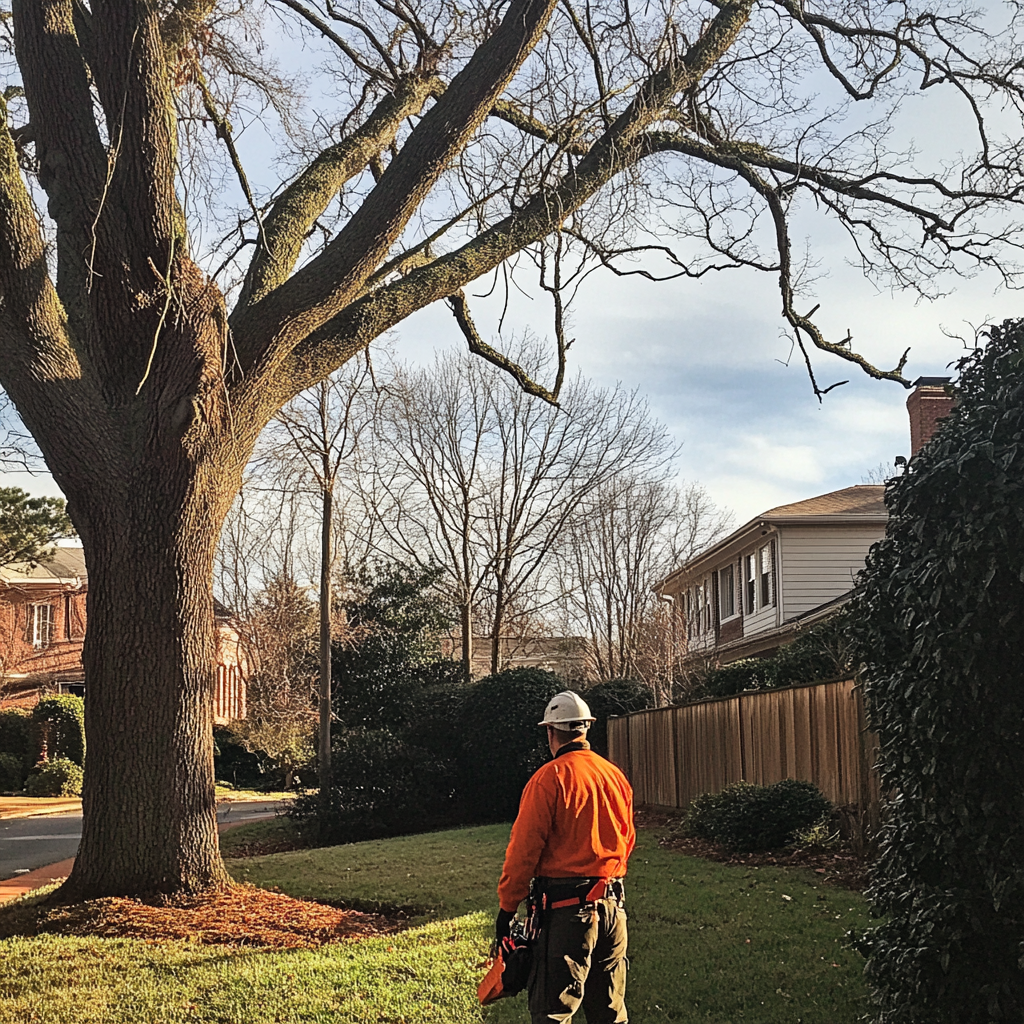
Some pruning work is entirely appropriate as a DIY project—deadheading, light shaping of small ornamentals, removing a few low branches from a young tree. Other situations call for a certified professional.
Call a professional when:
The work involves any branch larger than two to three inches in diameter, particularly near a structure. Large branches fail unpredictably during removal and require rigging experience and equipment to handle safely.
The tree has signs of disease, decay, or structural weakness. Pruning a diseased or structurally compromised tree without understanding the full picture can accelerate decline or create a safety hazard.
The tree is near power lines. Working near energized utility lines without proper training and equipment is genuinely dangerous and should never be attempted by homeowners.
You’re not sure what species you’re dealing with, when it should be pruned, or whether what you’re seeing is normal growth or a problem. A certified arborist can give you a clear answer in a short site visit and potentially save you from an expensive or irreversible mistake.
The tree is covered by local ordinances, HOA rules, or proximity to a road right-of-way. Many communities in the Manassas area have regulations about tree removal and significant pruning that homeowners aren’t always aware of.
What to look for in a tree service:
An ISA Certified Arborist on staff or directing the work. This credential means the individual has demonstrated knowledge of tree biology, pruning standards, and best practices through formal testing.
General liability insurance and workers’ compensation coverage. Request certificates before any work begins.
Familiarity with Northern Virginia species and local growing conditions. A company that works regularly in Prince William County will give you better species-specific advice than one that’s new to the area.
Clear, written estimates with an itemized breakdown of what’s included.
References from local customers, particularly for ornamental tree work.
A Practical May Pruning Calendar for Northern Virginia
To pull all of this together into something actionable:
Right now through mid-May — prune these if they’ve finished blooming: Dogwood, redbud, ornamental cherry, serviceberry, crabapple, saucer magnolia, fringe tree (if blooming is complete)
Wait until late winter 2027 to prune: Crepe myrtle, mimosa — these are summer bloomers and the structural pruning window is already closed for this season
Monitor but generally leave alone in May: Mature oaks, maples, and tulip poplars that are actively pushing new growth — unless there’s dead wood, a structural concern, or disease present
Avoid pruning in May: Anything showing active disease symptoms until you’ve had a professional assess it — particularly crabapples with fire blight signs or cherries with canker
Frequently Asked Questions
I pruned my dogwood in March and it barely bloomed this spring. Did I kill it? Almost certainly not. Pruning a spring bloomer before it flowers removes that year’s buds, which suppresses the bloom. The tree itself is fine. Let it grow through the full season without further pruning, and it will set buds normally for next spring. Prune it again right after it blooms next April.
My crepe myrtles have been topped for years. Can the form be restored? Often yes, though it takes patience. A gradual corrective approach—removing the worst stubs and selecting better-placed lateral branches over two or three seasons—can restore reasonable structure without shocking the tree. A certified arborist can map out a realistic plan based on what your specific trees look like.
Is May too late to prune a cherry tree? It depends on how far into May and what the weather has been doing. The ideal window is right after blooming—late April to early May in most Manassas years. If the tree has leafed out fully and the bloom was weeks ago, you’ve missed the prime window. In that case, wait until dry summer weather in late June or July, when bacterial canker pressure is lower, rather than pruning in wet May conditions.
How much does professional pruning cost for ornamental trees in the Manassas area? Costs vary significantly based on tree size, species, access, and scope of work. Small ornamental trees—a young dogwood or redbud—might run $150 to $300 for selective pruning. Larger established trees with structural concerns or proximity to structures will cost more. Get written estimates from two or three local companies and be cautious of bids that are significantly out of range in either direction.
Should I fertilize after pruning? Generally, established landscape trees in Northern Virginia don’t need supplemental fertilization after routine pruning. If your soil has been tested and shows a specific deficiency, targeted amendment makes sense. Blanket nitrogen fertilization after pruning can encourage excessive soft growth that’s more disease-susceptible. When in doubt, a soil test through Virginia Cooperative Extension will give you a science-based answer for your specific property.
What’s the best time of year overall for a tree health checkup? Late winter to early spring—before bud break—is an excellent time because the tree’s structure is fully visible and any dead wood or structural concerns are easier to spot. But an arborist visit any time of year is better than none. May is actually a fine time to have someone walk your property because active growth and flowering patterns can reveal a lot about a tree’s health that isn’t visible in winter.
Good Pruning Is an Investment in Years of Better Blooms
The flowering trees on a Manassas property are often the most visible and personally meaningful part of the landscape. A dogwood that’s been in the front yard for twenty years, a cherry tree that’s tied to a memory, a magnolia that was the whole reason you fell in love with the house—these trees deserve more than guesswork.
Getting the timing right, using good technique, and knowing when to hand the job to a professional are the three things that separate a landscape that delivers year after year from one that quietly underperforms. May is the month where a lot of this comes together—some trees are finishing their bloom cycle and are ready for attention, others need to be left alone, and a few calls or decisions made now will shape what your yard looks like next April.
Talk to United Tree Care About Your Flowering Trees This Spring
United Tree Care provides ornamental and flowering tree pruning throughout Manassas and Prince William County, with ISA Certified Arborists who understand the species, soil conditions, and seasonal rhythms that define Northern Virginia landscapes.
Whether you have a mature dogwood that needs a careful post-bloom pruning, crepe myrtles that have been topped for years and need corrective work, or simply want a professional set of eyes on your property before you pick up any tools—we can help.Contact United Tree Care today to schedule a spring tree care consultation in Manassas VA. We’ll walk your property, identify what needs attention and when, and give you a clear plan that protects your trees and keeps them performing at their best season after season.