Article Summary
- Overgrown trees in Manassas create layered risks that compound over time—structural hazards, property damage, utility conflicts, and foundation concerns often develop simultaneously
- The fast-growing native species that dominate Northern Virginia residential landscapes reach problematic size faster than most homeowners anticipate
- Many overgrown tree risks are invisible from the ground until they’ve already progressed significantly—professional assessment reveals what casual observation misses
- Property damage from overgrown trees extends well beyond obvious roof contact to include foundation systems, drainage infrastructure, hardscape, and neighboring properties
- Liability exposure for Manassas homeowners with overgrown trees creating known hazards is a real legal and financial consideration under Virginia property law
- The difference between a manageable pruning situation and a removal-or-emergency scenario is often just a few growing seasons of unaddressed growth
- Professional tree care in Manassas addresses overgrown tree risks proactively—before they generate the damage, liability, and emergency costs that neglect produces
- Because unaddressed tree growth can lead to compounding structural hazards and legal liability under Virginia property law, requesting to get your free estimate for tree care services today in Manassas, VA helps homeowners identify hidden risks and plan timely, cost-effective maintenance.
There’s a version of an overgrown tree problem that announces itself clearly—a branch through the roof after a storm, a root lifting the corner of the driveway so dramatically that you stub your toe on it every morning, a canopy so dense that the backyard grass has given up entirely. These situations are obvious. They generate action.
The version that actually costs Manassas homeowners the most money and causes the most harm is subtler. It’s the tree that has been growing toward the house for five years without anyone measuring how much the distance has closed. It’s the root system that has been working its way through the footing drain system for three growing seasons while the homeowner notices slightly more basement moisture but attributes it to the weather. It’s the scaffold branch that has been developing included bark at its union with the trunk through every summer while the tree continues to leaf out beautifully every spring.
Overgrown trees create risks across multiple categories simultaneously—structural, mechanical, biological, and legal—and those risks compound with every growing season that passes without professional tree care attention. This article covers all of them, specifically and practically, in the context of the Manassas area’s specific tree species, soil conditions, and development landscape.
Why Overgrown Trees Become Problems Faster in Manassas Than Elsewhere
Before getting into specific risk categories, it’s worth establishing why overgrown tree problems develop with the urgency they do in the Manassas area specifically.
The Growth Rate Reality
Manassas’s combination of hot summers, reasonable rainfall, and the rich Piedmont clay-loam soils that underlie most residential neighborhoods in Prince William County and the City of Manassas produces tree growth rates that surprise homeowners who moved here from slower-growing regions. The dominant species in the residential canopy—silver maple, tulip poplar, red maple, and various oaks—push their canopies outward and upward at rates that close the clearance between a tree and nearby structures faster than maintenance schedules built around other regions would anticipate.
A silver maple that was planted 15 feet from the house and seemed like an appropriate distance when it was 8 feet tall may be producing canopy contact with the roofline within 10 to 12 growing seasons in Manassas’s conditions. That same tree in a cooler, drier climate might take 20 years to reach the same relative size.
The practical implication is that tree care intervals that would be adequate in slower-growing regions are not adequate in Manassas. What constitutes a manageable pruning situation in year five becomes an overgrown hazard situation in year eight without professional attention in between.
The Mature Canopy Context
The established neighborhoods of Manassas—Old Town, Sudley, Stonewall Manor, and the many established residential streets throughout Prince William County—carry a mature tree canopy that includes large specimens of several species with a well-documented track record of becoming problematic when not professionally maintained. Silver maples with 40-inch trunk diameters. Tulip poplars that have been pushing toward 80 feet for 50 years. White oaks whose canopy spreads cover multiple lots simultaneously.
These trees were not overgrown when they were planted. They became overgrown because the relationship between their growth and their maintenance didn’t keep pace—because the pruning cycles were too infrequent, because removal decisions were deferred year after year, or because the original planting decisions placed trees in locations that were always going to produce eventual conflict with the structures and infrastructure that grew up around them.
Understanding that overgrown tree problems in Manassas are largely the product of accumulated deferred maintenance—rather than sudden events—is important because it shapes how to think about prevention, timing, and the urgency of professional assessment.
Structural Safety Hazards: When the Tree Itself Becomes the Risk
The most immediate and serious risks created by overgrown trees in Manassas are structural—situations where the tree’s size, its position, or the condition of its wood creates direct physical hazard to people and property.
Canopy Load and Branch Failure Risk
As trees grow beyond the size appropriate to their site, their canopy load—the total weight of branches, foliage, and any accumulated seed or fruit production—increases beyond what would exist in a properly maintained specimen. Overgrown canopies carry more weight on scaffold branches that may not have been structurally designed to support that load, create more wind resistance during storm events that generates higher dynamic forces on the branch unions, and in some species create the summer branch drop conditions described in detail elsewhere in this series.
The specific risk for Manassas homeowners is that overgrown canopy over driveways, walkways, decks, outdoor living areas, and roof surfaces is heavy canopy in exactly the locations where branch failure has the most immediate consequences. An overgrown silver maple whose canopy extends well over the roof is carrying that excess load directly over the structure it was never supposed to reach.
Professional crown management—crown thinning, crown reduction, dead wood removal—addresses excess canopy load before it creates failure conditions. Without it, load continues accumulating while structural capacity at branch unions may be declining simultaneously due to decay and the slow progression of included bark.
The Co-Dominant Stem Crisis at Scale
Many of the large overgrown trees in Manassas residential landscapes are silver maples that developed co-dominant stems—two or more main trunks arising from a single base—during their early years without the structural pruning that would have established a single dominant leader. These co-dominant arrangements, with their characteristic included bark unions that become more compressed and more structurally compromised as the stems grow larger and heavier, are among the most dangerous structural situations in the residential tree canopy.
A silver maple that was 20 feet tall with co-dominant stems was a minor structural concern. The same tree at 50 feet with 16-inch co-dominant stems carrying a full canopy load is a significant structural hazard—particularly when the included bark union is under tension from both stems’ weight and is exposed to the repeated dynamic loading of Manassas’s active storm season.
The window for addressing co-dominant stem situations through cabling and structural support closes as the trees grow—at some point the stems are too large and the structural situation too compromised for supplemental support to provide adequate safety margin. Professional tree care that identifies and addresses co-dominant stems while the trees are still at manageable size prevents the removal-or-hazard situation that delay produces.
Dead and Dying Wood in Overgrown Canopies
Overgrown trees—particularly those in conditions of stress from competition, soil compaction, pest pressure, or root damage—frequently carry significant dead and dying wood in their canopies. This dead wood is not evenly distributed through the canopy in ways that make it easy to see from the ground. It’s often concentrated in the interior of dense canopies where light penetration is insufficient to support continued growth, in the upper crown where early-stage decline first expresses itself, and at the endpoints of branches that have been in structural decline longer than the visible symptoms suggest.
Dead wood in the canopy of an overgrown tree over a residential property is a hazard that operates independently of storm conditions. Dead branches don’t need wind or rain to fall—gravity, vibration from nearby traffic, and thermal stress during summer heat are all sufficient to bring down dead wood that has been deteriorating in the canopy. Professional dead wood removal as part of a regular tree care program eliminates this continuous overhead hazard.
Property Damage: The Multiple Fronts of Overgrown Tree Impact
Structural safety hazards—the dramatic, visible risks—are only one dimension of what overgrown trees cost Manassas homeowners. The property damage that develops more slowly, across multiple systems simultaneously, often generates repair costs that dwarf the dramatic event scenarios.
Roof System Damage
Direct canopy contact with the roof surface is among the most financially consequential forms of overgrown tree damage for Manassas homeowners, and it’s one that develops gradually enough to be invisible until significant damage has accumulated.
The abrasion mechanism—branches in contact with asphalt shingles during wind wearing away the granule coating—operates continuously every time wind moves the canopy against the roof surface. The granule layer on asphalt shingles isn’t decorative. It’s the UV-resistant protective layer that prevents the underlying asphalt from degrading rapidly under direct sun exposure. Branches that wear away granules from a section of the roof accelerate aging in that area in ways that show up as premature failure long before the rest of the roof would need replacement.
A home inspector who notes localized granule loss concentrated in the area of branch contact is documenting a roof warranty issue, a premature replacement cost, and evidence of an ongoing tree-to-structure conflict—all in a single inspection note.
Beyond abrasion, overgrown branches resting on or near the roof create persistent moisture retention conditions. Leaves and debris accumulate in the contact zone, staying wet between rain events and creating a continuously damp environment that accelerates biological growth on roofing material—moss, algae, and in severe cases lichen—and that provides a pathway for moisture to work under shingle edges that should remain sealed.
Gutter System Overload
Overgrown trees over the roofline are gutter systems’ primary maintenance burden. Leaves, seeds, small branches, and biological debris falling from an overgrown canopy fill gutters in volumes and frequencies that no standard maintenance schedule can keep pace with. A silver maple with a 50-foot canopy spread dropping seeds and leaves into gutters produces volumes of debris that can fill even recently cleaned gutters within days during peak shed periods.
Gutters that are chronically overloaded stop functioning as water management infrastructure and become channels that deliver concentrated water directly to the foundation zone—precisely the location where water accumulation creates the foundation stress and basement moisture conditions that are themselves expensive to remedy.
The cost of professional gutter cleaning performed multiple times per year because of overgrown overhead canopy is a recurring expense that compounds over years. The cumulative investment in that repeated cleaning significantly exceeds the cost of professional crown management that would have reduced the debris load.
Siding and Exterior Finish Damage
The moisture microclimate created by overgrown canopy against or near the home’s exterior walls creates conditions that damage siding, trim, paint, and structural wood elements at an accelerated rate. Walls that don’t dry adequately between rain events because dense overhead and adjacent canopy keeps them in shade retain moisture long enough for biological growth—moss, algae, mold—to establish on the surface.
Wood siding and trim in the chronic moisture zone of an overgrown tree develops the surface biological growth and subsurface moisture infiltration that leads to rot. The progression from cosmetic surface discoloration to structural rot in wood elements at grade level—sill plates, rim joists, deck framing—is measured in years rather than decades when moisture conditions are consistently unfavorable.
Vinyl siding under the same chronic moisture conditions doesn’t rot, but it develops algae staining that requires pressure washing and in advanced cases treatments that damage the surface. Masonry elements—brick, stucco—in the chronic moisture zone of overgrown canopy develop efflorescence, spalling, and in freeze-prone conditions like Manassas winters, frost damage as moisture in the masonry expands during freeze cycles.
Foundation and Drainage System Impacts
The root system impacts of overgrown trees on residential foundations and drainage infrastructure were covered in detail in the foundation article in this series. The summary relevant here is that overgrown trees—particularly large, high-water-demand species like silver maple—create soil moisture dynamics in the foundation zone that directly contribute to the clay soil shrink-swell cycles responsible for foundation settlement, cracking, and differential movement.
Trees that have grown to a size beyond their appropriate site size are extracting water from the foundation zone at volumes beyond what would be created by a properly sized specimen. The soil moisture deficit they create during summer drought periods in Manassas’s clay soils is proportional to their size—a 50-foot silver maple creates a much larger soil moisture impact in the foundation zone than a 25-foot specimen of the same species would.
Drainage infrastructure—footing drains, downspout discharge systems, and sewer laterals—is particularly vulnerable to root intrusion from overgrown trees whose root systems have had more seasons to extend into the areas where drainage infrastructure runs. A root system that reaches a footing drain joint or a sewer lateral crack and finds the moisture and nutrients inside will colonize that infrastructure and grow until it blocks flow.
Hardscape and Site Infrastructure
The lifted driveway panels, displaced patio pavers, cracked retaining walls, and disrupted walkways that characterize properties with overgrown trees are both aesthetic problems and functional liabilities. They create trip hazards, direct water in unintended directions, and signal to buyers and visitors that the property has been in an ongoing losing battle with its tree canopy.
The economics of repeated hardscape repair without addressing the underlying root cause—the overgrown tree whose root system is doing the lifting—are straightforwardly unfavorable. Pavers that are reset without root management or removal will be lifted again. Retaining walls that are repaired without addressing the root system that displaced them will be displaced again. Each repair cycle costs money that accumulates toward a total that would have been more than sufficient to address the root cause—literally—at the outset.
Utility and Infrastructure Conflicts From Overgrown Trees
Overgrown trees interact with utility infrastructure in ways that create risks and costs that extend beyond the property itself.
Power Line Contact and Conflict
Trees that have grown into or near overhead power lines create utility conflicts that involve not just the homeowner but Dominion Energy Virginia, the broader electrical grid reliability, and in some configurations, neighboring properties that share circuit segments.
Branches in contact with overhead distribution lines create fault conditions that can cause outages—sometimes to the single property, sometimes to entire neighborhoods depending on how the circuit is configured. They also create fire risk during dry periods when arcing from branch contact can ignite nearby material.
Dominion Energy Virginia’s vegetation management program trims trees near their lines on a cycle that prioritizes circuit reliability over the aesthetic concerns of individual homeowners. Trees that have grown into utility right-of-way corridors may be trimmed by the utility in ways that are effective for line clearance but damaging to the tree’s structure—creating the stub cuts and unbalanced canopy that generate more problems than they resolve.
Proactive professional tree care that maintains appropriate clearance from overhead lines—on the homeowner’s schedule, using proper arboricultural techniques—produces better outcomes for both the tree and the utility infrastructure than reactive utility trimming after contact has already been made.
Underground Utility Conflicts
The underground utility infrastructure beneath Manassas residential properties—water lines, sewer laterals, gas lines, telecommunications conduits, and electrical service entrances—runs through the root zones of overgrown trees in ways that aren’t mapped or visible on the surface.
Overgrown trees develop root systems in proportion to their canopy size—larger canopy means larger root system, which means more extensive underground reach into the areas where utility infrastructure runs. Root intrusion in sewer laterals is the most common manifestation of this conflict, producing the slow drains, recurring backups, and eventual camera inspection results that reveal root masses blocking the pipe.
Gas line conflicts are less common but significantly more serious when they occur. Root growth that displaces or damages gas line joints creates the conditions for leaks that may go undetected until the concentration reaches a dangerous level.
Shared Access and Neighboring Property Conflicts
Overgrown trees near property lines create conflicts with neighboring properties that can generate neighbor relationship complications, HOA disputes, and in some cases legal proceedings that are significantly more expensive and disruptive than the professional tree care that would have prevented them.
Virginia property law gives property owners the right to trim overhanging branches back to the property line, but that right has limits—work that harms the tree as a whole, work that requires entering the neighbor’s property, and situations where the overhang has already caused damage create legal territory that is messy and expensive to navigate.
Overgrown trees near property lines in Manassas’s established residential neighborhoods—where lots are often tight and tree canopies easily span the line—are among the most common sources of neighbor disputes that professional tree care could have prevented.
Pest and Disease Amplification in Overgrown Trees
Overgrown trees aren’t just structurally compromised—they’re biologically vulnerable in ways that create pest and disease risks that healthy, well-maintained trees resist more effectively.
The Stress-Susceptibility Connection
Trees under chronic stress—which is what overgrown trees frequently are, dealing simultaneously with the physiological demands of excessive size, root zone competition, soil compaction, and potential drought stress—are measurably more susceptible to secondary pest infestations and disease establishment than trees in good health and appropriate condition.
The relationship between tree stress and pest susceptibility is well-documented in the arboricultural literature. Bark beetles and wood-boring insects that are opportunistic—targeting trees that have reduced capacity to defend themselves through resin flow and other chemical defense mechanisms—are attracted specifically to stressed trees. An overgrown silver maple dealing with co-dominant stem stress, drought stress from its oversized root zone demand, and the soil compaction that characterizes many Manassas residential lots is providing precisely the stress signals that attract secondary pest activity.
In the Northern Virginia pest context—with spotted lanternfly populations established throughout the region and wood-boring species active throughout the warm season—overgrown stressed trees in Manassas residential landscapes are more vulnerable than maintained specimens of the same species.
Fungal Disease Entry Through Mechanical Damage
Overgrown trees that are in contact with structures, utilities, or other trees accumulate mechanical wounds—abrasion, bark damage, branch contact points—that serve as entry sites for the wood decay fungi that are ubiquitous in Manassas’s soil and air environment. Branches rubbing against roof surfaces, against each other in a dense overgrown canopy, or against utility lines develop chronic wound conditions that healthy bark would seal but that compromised trees can’t callus over adequately.
Each wound site on an overgrown tree is a potential fungal entry point, and an overgrown tree with dozens of wound sites from chronic contact is accumulating decay entry points at a rate that even a vigorous tree would struggle to manage.
The Liability Dimension: Legal and Financial Exposure
The legal and financial liability associated with overgrown trees is a consideration that Manassas homeowners rarely think about proactively but that becomes very relevant after an incident.
Premises Liability Under Virginia Law
As covered in the overhead limb article in this series, Virginia property owners owe a duty of reasonable care to people who come onto their property—and that duty extends to maintaining trees in a condition that doesn’t create unreasonable hazard to visitors.
Overgrown trees create specific premises liability exposure because their hazardous conditions are often knowable—the overhanging branch is visible, the leaning trunk is visible, the dead wood in the canopy is visible—and failure to address knowable hazards after they’re identified is the legal definition of negligence.
The homeowner who has noticed for two seasons that a large overgrown branch extends over the driveway and who hasn’t arranged for its removal is in a materially worse legal position when that branch falls on a visitor’s vehicle or person than a homeowner whose tree failed without visible prior indication.
Neighbor Property Damage and Insurance Implications
When an overgrown tree fails and causes damage to a neighbor’s property—vehicle, fence, structure, landscaping—the liability question in Virginia depends on whether negligence can be established. As covered in multiple articles in this series, prior knowledge of a tree’s hazardous condition and failure to act on that knowledge is the key factor that moves liability from an act-of-nature situation to a negligence situation.
Documentation of prior complaints—a neighbor’s text message asking about the leaning tree, an HOA notice about a tree requiring attention, a prior tree service assessment that identified the hazard and was not acted upon—is exactly the kind of evidence that establishes prior knowledge in a liability proceeding.
The financial implications of neighbor property damage claims, adjusted against homeowner’s liability coverage with its attendant deductibles and potential premium impacts, are consistently more expensive than the professional tree care that would have prevented the situation.
HOA Compliance Liability
For Manassas homeowners in communities with active HOAs, overgrown trees that have generated HOA notices, complaints from neighbors, or documented correspondence about maintenance obligations create compliance liabilities that affect both the ongoing HOA relationship and the property’s marketability at sale.
An HOA violation history related to tree maintenance that appears in the property’s records during a sale transaction creates disclosure obligations, title complications, and buyer concerns that professional tree care—done before the violations accumulated—would have entirely prevented.
What “Overgrown” Actually Looks Like: The Assessment Framework
Understanding which trees on a Manassas property are genuinely overgrown versus which are simply mature helps homeowners prioritize professional attention appropriately.
The Clearance Indicators
Branches in contact with or within a few feet of roof surfaces, gutters, siding, or utility lines are the most obvious indicators of canopy that has exceeded appropriate size for its position. Professional tree care standard practice maintains minimum clearances between canopy and structures—typically at least 10 feet from the roof surface for deciduous trees, more for species with heavy fruit or seed production that could damage roofing.
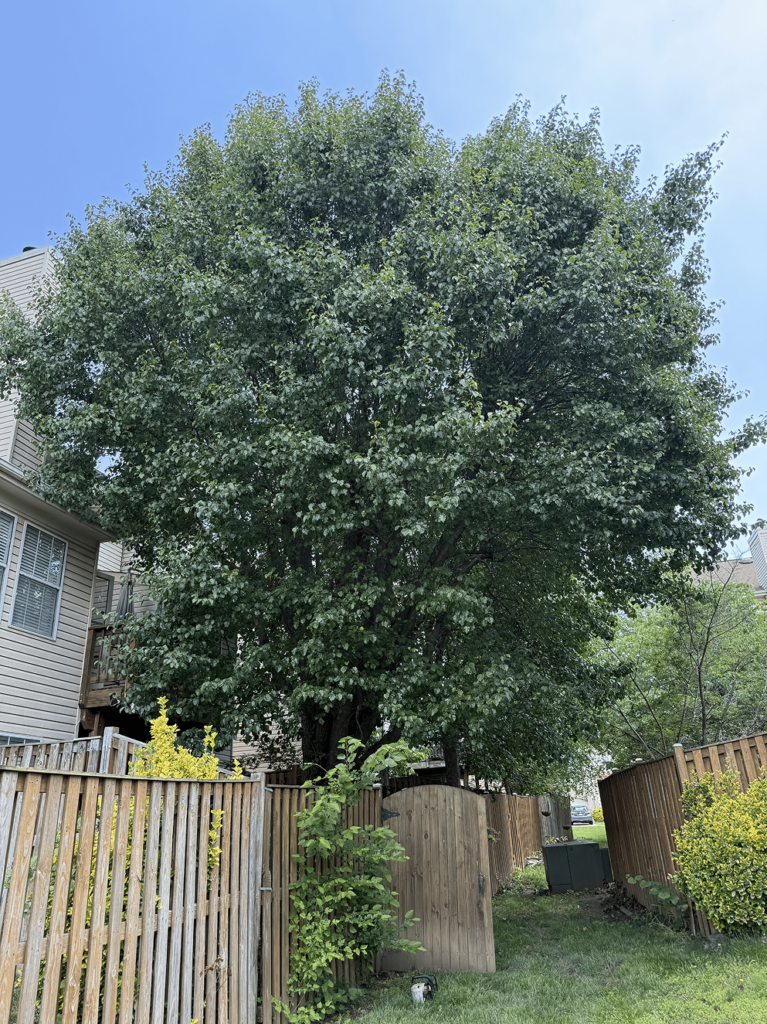
Trees whose trunks are within 15 to 20 feet of the foundation and whose canopy extends above the structure have typically grown beyond the site’s appropriate capacity for the species—regardless of how healthy the tree appears.
The Structural Indicators
Co-dominant stems that have developed visible included bark, scaffold branches that are unusually heavy relative to the trunk diameter supporting them, or canopy arrangements that are significantly asymmetric—heavy on one side relative to the other—are structural indicators of trees that have grown beyond the point where their architecture is self-supporting without professional intervention.
The Canopy Density Indicators
A canopy that has become so dense that meaningful light penetration to the space below no longer occurs, that creates chronic moisture conditions on surfaces beneath it, or that has closed to the point where dead interior wood is accumulating faster than the tree is shedding it naturally is a canopy that has exceeded its optimal maintenance state.
The Root Zone Indicators
Lifted hardscape surfaces within the drip line of a large tree, soil heaving or cracking around the root collar after rain events, and chronic drainage problems in areas adjacent to a mature tree’s root zone are all indicators that the tree’s root system has grown beyond the capacity of the available soil volume to accommodate it without creating conflicts with nearby infrastructure.
The Tree Care Response to Overgrown Tree Risks
The good news embedded in everything covered above is that overgrown tree risks are largely manageable—provided professional tree care attention is engaged before the situation progresses to the point where the only remaining option is removal under difficult or emergency conditions.
Crown Management as Risk Reduction
Professional crown management—thinning, reduction, raising, and dead wood removal performed by an ISA-certified arborist following ANSI A300 standards—directly addresses the structural, mechanical, and biological risks created by overgrown canopy. It reduces the load on compromised branch unions. It improves clearance from structures and utilities. It removes the dead and dying wood that creates the most immediate overhead hazard. And it restores the canopy density to a level where the tree can maintain itself more sustainably.
Crown management is most effective when it’s performed before the canopy has grown to the point where the scale of the work required exceeds what can be accomplished without removing more than the appropriate percentage of live crown in a single pruning cycle. The ANSI standard of not removing more than 25 percent of a tree’s live crown in a single session means that trees that have grown significantly beyond appropriate size may require multiple pruning cycles over several years to bring them back to managed condition.
Getting ahead of overgrowth before it reaches this scale—scheduling professional pruning before the tree has grown to the point where adequate correction requires multiple seasons—is the most effective and most economical approach.
Root Management Options
For overgrown trees whose root systems are creating conflicts with foundation drainage, hardscape, or utility infrastructure, professional root pruning and root barrier installation can limit ongoing root intrusion into protected zones. These interventions don’t eliminate the root system—they redirect it, providing some relief to affected infrastructure while preserving the tree.
Root management is most effective as a supplemental measure alongside crown reduction—reducing the crown’s demand for water reduces the root system’s drive to expand into areas where that water is available.
Strategic Removal and Replacement
For trees that have grown beyond the point where crown management and root management can adequately address the risks they create—trees too close to the foundation at a scale where root management is insufficient, trees with structural conditions that make adequate crown management impractical, trees of species that will always create the same problems as they grow back—professional removal with strategic replacement planting is the most effective long-term risk management approach.
Replacement planting that selects species appropriate to the site—mature size matched to available space, root architecture appropriate to nearby infrastructure, growth rate matched to maintenance capacity—eliminates the overgrowth cycle at its source. A serviceberry or native dogwood planted where the silver maple came down will never create the same set of problems, because its mature size is appropriate to the site rather than requiring continuous management to keep it there.
The Timing and Cost Argument for Acting Now
The economics of overgrown tree risk management in Manassas follow a consistent pattern that favors earlier action over later action across every risk category covered in this article.
Roof damage that accumulated from overgrown branch contact over three seasons costs more to repair than the crown management that would have maintained clearance. Foundation drainage issues attributable to root intrusion cost more to address than root management would have. Emergency removal of a structurally compromised overgrown tree after it fails partially costs more than planned removal before failure. Neighbor property damage claims from an overgrown tree that was known to be problematic cost more—in financial and relationship terms—than the professional tree care that would have prevented the incident.
The pattern is consistent enough that it functions almost as a rule: early professional tree care investment in addressing overgrown tree conditions costs a fraction of the reactive costs that delay produces.
Address Overgrown Tree Risks With United Tree Care
Overgrown trees in Manassas don’t fix themselves. They grow larger, their root systems extend further, their structural compromises progress further, and the risks they create expand with every season that passes without professional attention.
United Tree Care provides professional tree care throughout Manassas and Northern Virginia—including the assessment, crown management, root evaluation, and removal services that address overgrown tree risks before they produce the property damage, safety incidents, and liability exposure that neglect eventually generates.
The team brings ISA-certified arborist expertise to every assessment, genuine knowledge of the specific species and conditions that create overgrown tree situations in the Manassas area, and the professional standards that distinguish tree care done right from work that temporarily addresses the visible symptom without resolving the underlying situation.
If you have trees on your Manassas property that have grown beyond where they should be—or if you’re not sure where your trees stand relative to the risks described in this article—reach out to United Tree Care for a professional assessment. The right professional tree care, applied at the right time, is the difference between trees that are genuine assets to your Manassas property and trees that are gradually becoming its most expensive problem.