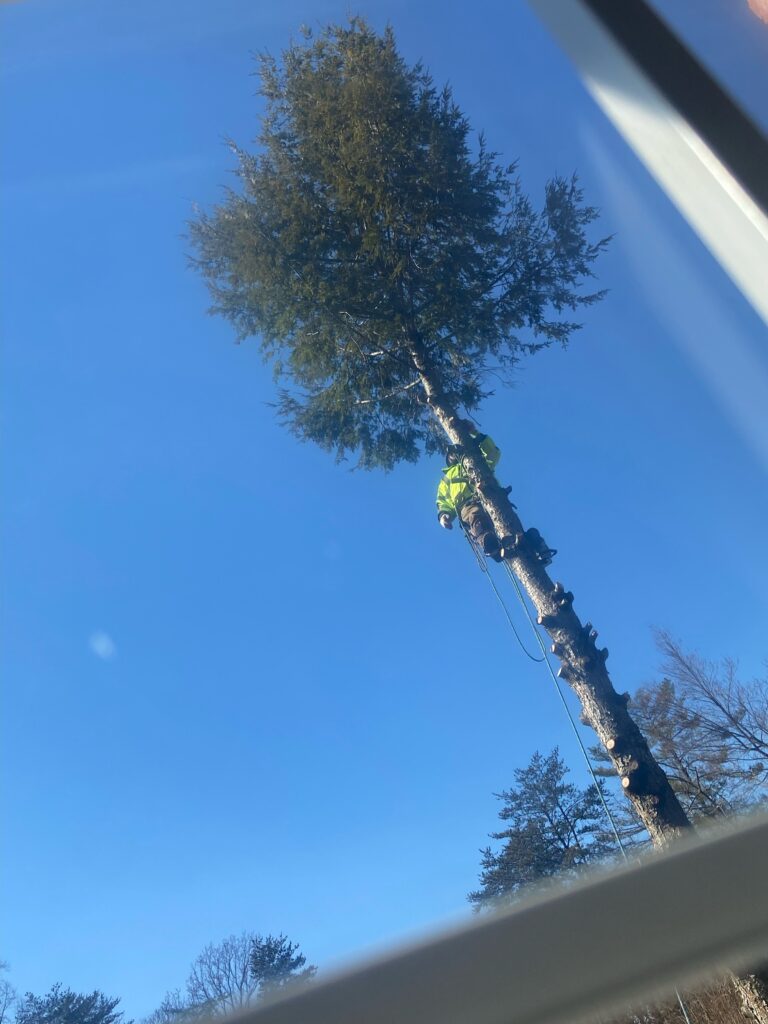
Knowing how to cut trees properly in Manassas, VA starts with two things: understanding your specific tree species and choosing the right season. Get either of those wrong, and you risk injuring the tree, voiding your homeowner’s insurance, or running into trouble with Manassas city regulations.
Key Takeaways
- Late winter (February through early March) is the best window for most tree cutting in Northern Virginia, before sap rises and insects become active.
- Manassas has local ordinances and many neighborhoods have HOA rules that may require permits or restrict removal without approval.
- Common Northern Virginia trees like Virginia pine, red maple, and white oak each have different pruning needs and timing requirements.
- Crown thinning, crown reduction, and deadwooding are three distinct techniques, and choosing the wrong one can permanently damage your tree.
- Professional tree cutting in Manassas typically costs between $300 and $1,500+ depending on tree size, location, and access.
- United Tree Care offers free estimates and 24/7 emergency response for Manassas and the surrounding Northern Virginia area.
Tree Services Available in Manassas and Northern Virginia
Tree care in the Manassas area covers a wide range of services, not just basic trimming. Homeowners in Prince William County deal with a dense canopy of native hardwoods, fast-growing ornamentals, and storm-prone softwoods. The right service depends on what problem you’re solving.
Here’s a breakdown of the most common tree cutting and care services available in this region:
| Service | What It Does | Best For |
| Crown Thinning | Removes select inner branches to increase airflow | Overgrown maples, dense oaks |
| Crown Reduction | Reduces overall canopy size proportionally | Trees near power lines or structures |
| Deadwooding | Removes dead, dying, or diseased limbs | Disease prevention, safety hazard removal |
| Tree Removal | Full removal of tree and stump | Dead trees, invasive species, hazard trees |
| Stump Grinding | Grinds remaining stump below grade | Post-removal cleanup, lawn reclamation |
United Tree Care provides all of these services across Manassas, Northern Virginia, and the wider Washington, DC metro area, with certified arborists and competitive pricing on every job.
Why United Tree Care Is the Right Choice for Manassas Homeowners
Choosing the right tree care company in Northern Virginia is not just about price. You want a team with local knowledge, proper certifications, and a track record that holds up in your specific neighborhood, not just across a generic service area.
United Tree Care has built over 15 years of hands-on experience serving Manassas and surrounding communities in Prince William County. Here’s what sets the team apart:
- Certified arborists on staff who understand Virginia-native species, soil conditions, and local climate patterns
- Advanced equipment including aerial lift trucks, precision saws, and rigging systems for tight residential spaces
- Free estimates so you know your costs before any work begins
- 24/7 emergency response for storm damage, fallen limbs, or hazard trees that can’t wait
- Competitive pricing without sacrificing quality or safety compliance
When a major storm rolls through Prince William County, the difference between a company that knows Manassas streets and one that doesn’t shows up fast. United Tree Care’s local roots mean faster response, better situational awareness, and zero guesswork about access and disposal routes.
Why Tree Trimming and Cutting Matters for Your Residential Property
A lot of homeowners treat tree trimming as a cosmetic issue. It’s actually a structural and safety concern first. Here’s what’s really at stake when you skip regular tree maintenance on your Northern Virginia property:
Structural integrity: Weak branch attachments, co-dominant stems, and deadwood can fail without warning, especially during the ice storms and high-wind events that hit the Manassas area every winter and spring.
Property damage risk: A 40-foot red oak branch falling onto your roof costs far more than routine trimming. Homeowner’s insurance claims related to tree damage often involve disputes about whether the damage was foreseeable, meaning a poorly maintained tree may not be fully covered.
Disease spread: Northern Virginia trees face real threats from oak wilt, emerald ash borer, and fungal pathogens. Leaving infected limbs in place allows disease to spread through the vascular system of the tree and, in some cases, to neighboring trees through root grafts.
Utility conflicts: Trees growing into Dominion Energy power lines in Prince William County create outage risks. Dominion does conduct its own trimming program, but their cuts are not always made with the tree’s health in mind.
Curb appeal and property value: A well-maintained tree canopy can add 10-15% to property value according to multiple U.S. Forest Service studies. Unkempt trees with deadwood and crossing branches signal deferred maintenance to buyers.
The Real Benefits of Getting Your Trees Professionally Cut
Professional tree cutting goes well beyond what a homeowner with a chainsaw can accomplish safely. Here’s what you actually gain:
- Species-appropriate cuts: A certified arborist knows that flush cuts (cutting flush to the trunk) are outdated and harmful. The correct cut preserves the branch collar, which allows the tree to compartmentalize decay naturally.
- Proper tool calibration: Dull or unsterilized blades spread disease between trees. Professionals sterilize cutting tools between jobs, especially critical in oak wilt season (April through July in Virginia).
- Liability protection: If a hired professional causes damage, their insurance covers it. If you’re on a ladder with a chainsaw and something goes wrong, your health insurance and homeowner’s policy may not cooperate.
- Waste management: Professional crews handle chip removal, log splitting, and haul-away. You’re not left with brush piles that violate Prince William County disposal rules.
The Step-by-Step Process of Professional Tree Cutting
Understanding the process helps you evaluate any quote you receive and ask the right questions. Here’s how a professional tree cutting job should unfold in Manassas:
- Site assessment: The arborist walks the property, identifies species, checks for structural defects, and notes proximity to structures, utilities, and fences.
- Work plan and quote: You receive a written scope of work with clear pricing before anything starts. No reputable company begins cutting without this.
- Permit check: For significant removals, the arborist confirms whether a Manassas city permit or HOA approval is required.
- Equipment setup: Ground protection mats, cones, and rigging lines are placed. This step is often skipped by low-bid crews, leading to lawn damage and liability disputes.
- Top-down removal or selective pruning: Depending on the job, the crew works from the top of the canopy downward, removing sections in a controlled sequence.
- Branch collar preservation: Every cut is made just outside the branch collar, never flush with the trunk and never leaving a stub.
- Chipping and cleanup: Brush goes through the chipper, logs are cut to manageable lengths for disposal or firewood splitting, and the entire area is raked.
- Final walkthrough: The arborist reviews the result with you before the crew leaves.
Things to Know
- Manassas city ordinances may require a permit to remove trees above a certain diameter. Always check with the City of Manassas Public Works Department before removal.
- HOA restrictions in communities like Sudley Manor and Signal Hill add another layer of approval. Review your HOA bylaws before scheduling any tree work.
- Virginia’s oak wilt season runs April through July. Avoid pruning oaks during this window unless absolutely necessary, and if you must, apply wound sealant immediately.
- The 25% rule is a starting point, not a guarantee. Never remove more than 25% of a tree’s live crown in a single season, but some stressed trees need even less.
- Stump treatment matters: An untreated stump from a disease-prone species can harbor fungal growth that spreads to nearby trees through soil contact.
- Emergency tree work after storms may still require permits in Manassas for full removal, even if the situation feels urgent. Call a professional who knows local protocol.
Seasonal Tree Cutting Calendar for Northern Virginia
Timing is one of the most overlooked variables in tree care. Here’s a practical seasonal guide for Manassas homeowners:
| Season | Best For | Avoid |
| Late Winter (Feb-Mar) | Most pruning, structural cuts, dormant season removals | Cutting oaks if temps rise suddenly |
| Spring (Apr-May) | Deadwooding, light crown cleaning | Pruning oaks (oak wilt risk), heavy cuts on stressed trees |
| Summer (Jun-Aug) | Hazard removal, emergency work only | Major pruning on most hardwoods |
| Fall (Sep-Nov) | Inspection and planning, light cleanup cuts | Heavy pruning (new growth won’t harden before frost) |
| Early Winter (Dec-Jan) | Dormant pruning on most hardwoods, visibility inspection for structure | None, generally the second-best window |
Safety Gear and Equipment Required for Tree Cutting
Safety equipment is not optional. Even small trimming jobs carry real risk. Here’s what professionals use and what homeowners should consider if attempting minor work:
For homeowners doing light trimming (under 10 feet, no chainsaw):
- Certified climbing helmet with face shield
- Cut-resistant gloves rated for hand protection
- Eye protection (safety glasses, not sunglasses)
- Non-slip footwear
- Fiberglass ladder rated for your weight plus tool weight
Professional-grade equipment used by United Tree Care:
- Aerial lift trucks for canopy access without climbing
- Friction saver ropes and arborist saddles for rigging
- Chainsaw chaps and Class E hard hats
- Ground crew communication equipment
- Wood chipper and stump grinder
The moment a job involves a chainsaw, a ladder above 10 feet, or any proximity to a power line, it crosses from homeowner territory into professional territory. No savings are worth a trip to the ER or a lawsuit from a neighbor.
Practical Tips for Safe Tree Trimming in Manassas
If you’re handling minor trimming on small ornamentals or low-hanging branches, these tips apply directly to Northern Virginia conditions:
- Identify your tree species first. Virginia-native trees like white oak, tulip poplar, and American sycamore each respond differently to cuts. Misidentification leads to bad timing and improper technique.
- Sharpen your tools before every session. A clean cut closes faster and resists disease better than a ragged one from a dull blade.
- Cut at a slight downward angle away from the bud. This sheds water and reduces rot at the cut surface.
- Never top a tree. Topping (cutting the main trunk or large scaffold branches to stubs) is condemned by both the ISA (International Society of Arboriculture) and TCIA (Tree Care Industry Association). It creates hazardous regrowth and permanently damages tree structure.
- Check for animal activity first. Northern Virginia trees often host nesting birds, especially in spring. Disturbing an active nest may violate the federal Migratory Bird Treaty Act.
- Call 811 before any ground-level work. If you’re removing a stump or cutting a tree with roots near a gas or utility line, calling 811 (Virginia’s “Call Before You Dig” line) is required by law.
Ready to Schedule a Free Tree Cutting Estimate in Manassas?
Contact United Tree Care today to schedule your no-cost, no-obligation property assessment. Tell the team what you’re dealing with, whether it’s a hazard oak near your house, an overgrown maple crowding the fence line, or storm damage that needs immediate attention, and a certified arborist will walk your property and give you a clear, written quote. Call or request your free estimate online and get a professional opinion before picking up a single tool.
Regenerate section
Frequently Asked Questions
Q: Do I need a permit to cut down a tree on my property in Manassas, VA?
It depends on the tree’s size and location, and in some cases, HOA rules apply as well.
The City of Manassas has ordinances governing tree removal, particularly for larger specimens or trees in certain zones. You should contact the City of Manassas Public Works Department before removing any significant tree. If you live in a neighborhood with an HOA, a separate approval process may also apply.
Q: What is the best time of year to trim trees in Northern Virginia?
Late winter, from February through early March, is generally the best window for most tree species in the Manassas area.
During dormancy, trees are less vulnerable to insect infestation and disease entry through fresh cuts. The one major exception is oaks, which should not be pruned between April and July due to oak wilt transmission risk.
Q: How much does professional tree trimming cost in Manassas, VA?
Most residential tree trimming jobs in Manassas range from $300 to $1,500, depending on tree size, species, and access.
Full tree removal, especially of large hardwoods close to structures, can exceed $2,000. United Tree Care offers free estimates so you can get an accurate number for your specific situation before committing to any work.
Q: What is the difference between crown thinning and crown reduction?
Crown thinning removes select branches throughout the canopy to improve airflow, while crown reduction decreases the overall size of the canopy proportionally.
Thinning is the right choice when a tree is simply overgrown and blocking light. Reduction is more appropriate when a tree is growing into power lines, a roofline, or another structure. Both require proper technique to avoid long-term damage.
Q: Can I trim a tree near a power line myself in Manassas?
No. Trimming within 10 feet of an energized power line requires a licensed line-clearance arborist and is illegal for unlicensed individuals in Virginia.
Dominion Energy manages its own trimming program near transmission lines, but for distribution lines near your home, you’ll need to contact your utility or hire a certified crew. United Tree Care handles utility-adjacent work with the proper credentials and equipment.
The Bottom Line on How to Cut Trees Properly in Manassas VA
Understanding how to cut trees properly in Manassas VA is not just about technique. It involves local regulations, species knowledge, seasonal timing, and a clear-eyed assessment of when a job is truly safe for a homeowner versus when it requires a professional crew. The cost of getting it wrong ranges from a damaged tree to serious personal injury.
United Tree Care has served Manassas and Northern Virginia for over 15 years with certified arborists, advanced equipment, and a commitment to doing the job right the first time. Reach out today for your free estimate and let the team handle the complexity while you protect your property and your peace of mind.