Quick Takeaways
- May is one of the most active severe weather months in Northern Virginia, bringing high winds, heavy rain, and storms that can take down trees with little warning.
- Many tree failures during storms are preventable with the right pre-season inspections and targeted maintenance.
- Knowing the difference between a hazardous tree and a stressed-but-stable one can save you thousands of dollars—and protect your family.
- Emergency tree removal in Manassas comes with specific local permitting and utility coordination requirements that homeowners often don’t know about until a tree is already down.
- Response time and equipment matter after a storm—choosing the right tree service company before an emergency happens puts you in a much better position.
- Beyond storm safety, protecting your landscape in 2026 requires staying informed on local Manassas box tree moth regulations to prevent the spread of this invasive species during routine yard work.
May in Manassas has a way of keeping you on your toes. One afternoon, you’re watching kids play in the yard under a clear sky, and by evening, a line of thunderstorms is rolling through Prince William County with winds that bend mature oaks sideways. The mid-Atlantic spring is beautiful, but it’s also when the weather gets serious—and trees that have been quietly weakening through a wet winter and early spring can come down fast when conditions turn.
For homeowners across Manassas, this time of year is worth a hard look at the trees on their property. Not a paranoid one—most mature trees are fine, and good tree care is about informed decisions, not fear. But a house with a 70-foot white oak overhanging the roofline, or a silver maple with a split leader leaning toward the fence line, deserves some attention before storm season gets into full swing.
This article walks through what you actually need to know: the storm patterns that affect Manassas in May, how to read your trees for warning signs, what happens after a tree comes down, and how to get ahead of it all with the right professional help.
Why May Is a High-Risk Month for Trees in Manassas
Northern Virginia sits in a region where spring weather systems can be genuinely violent. May specifically brings a combination of factors that make tree failures more likely than almost any other month of the year.
The Weather Pattern
By May, the jet stream has shifted and the Gulf of Mexico is pumping warm, moisture-laden air into the Mid-Atlantic. When that collides with cold fronts still pushing down from the north, the result is often severe thunderstorm lines—the kind that produce straight-line winds of 50 to 70 mph, intense downbursts, and occasional tornadoes. The Manassas area has seen all three.
Unlike the gradual building of a hurricane, these systems can develop within hours. The National Weather Service office in Sterling, which covers Prince William County, regularly issues Severe Thunderstorm Watches and Warnings between May and September, but the lead time is sometimes measured in minutes rather than days. That’s not a lot of time to do anything about a weak tree hanging over your house.
The Soil Factor
One thing that makes spring storms particularly dangerous for trees in this area is the soil. Manassas and the surrounding parts of Prince William County have a high percentage of heavy clay, and by May that clay is often saturated from spring rains. Saturated soil dramatically reduces the anchoring strength of a tree’s root system. A tree that would withstand 60 mph winds in dry summer conditions can uproot entirely in the same winds when the ground has been wet for days. This is why so many of the tree failures after major storms involve uprooting rather than trunk breakage—the tree was structurally sound, but the ground gave out beneath it.
Full Leaf Canopy = More Wind Load
By late April and into May, most deciduous trees in Manassas have leafed out fully. A full canopy acts like a sail in high winds. The same tree that passes wind easily in March—when it’s bare—catches enormous force in May. This multiplied wind load is one of the primary reasons storm-related tree failures spike in spring and summer compared to late fall and winter.
Reading Your Trees: Warning Signs That Shouldn’t Be Ignored
Most catastrophic tree failures don’t happen without warning. The signs are often there for months or even years—they just require knowing what to look for. Walk your property with this list in mind, especially before storm season peaks.
Deadwood in the Canopy
Dead branches—sometimes called “widow makers” by arborists—are one of the most common sources of storm damage. A live branch bends under wind load. A dead branch snaps, sometimes with tremendous force. Look up through your tree canopies for branches that have no leaves when the rest of the tree is leafed out, or for branches with gray, dry bark that’s starting to peel or crack.
Large deadwood in a tree that overhangs your house, a parked car, or a play area is not something to monitor from a distance—it’s something to have removed before storm season.
Cracks, Splits, and Included Bark
A crack in a tree trunk or a major limb junction is a serious structural warning. One particularly problematic condition is called “included bark”—this happens when two stems or major branches grow so closely together that bark gets compressed between them instead of forming a solid wood union. The result is a structurally weak junction that can fail suddenly under load, even without obvious external decay.
Co-dominant stems—where a tree has split into two roughly equal trunks—are common in species like Bradford pears (still found on a lot of older Manassas properties), silver maples, and some oaks. These junctions need to be evaluated by a professional. Sometimes cabling or bracing can provide structural support. Sometimes removal of one stem is the right answer.
Fungal Growth at the Base or on the Trunk
Mushrooms, conks, or shelf fungi growing at the base of a tree or on the lower trunk are a reliable indicator of internal decay. The fruiting body you see on the outside is the result of fungal colonization that has already been working through the wood inside for some time. Trees with significant basal decay can look perfectly normal from 20 feet away and be dangerously hollow at the root collar.
In the heavy clay soils common around Manassas, root rot is a particular concern because poor drainage keeps the base of the tree consistently wet. If you see fungal growth on a tree near your home, schedule a professional assessment before the storm season is underway.
Leaning
Some trees naturally grow with a slight lean—this isn’t inherently a problem. What’s worth paying attention to is a lean that has developed or changed noticeably over a short period of time, particularly if accompanied by soil heaving or cracking at the base of the tree. This can indicate root failure and is one of the most urgent warning signs a tree can show.
Root Zone Damage
Construction, trenching, and driveway or sidewalk work near trees can sever roots and compromise stability without the damage being visible in the canopy for months or even years. If your property has had utility work, additions, or hardscape changes in the last three to five years, think about which trees are in the vicinity and whether they’ve had a professional assessment since that work was done.
Crown Dieback
When the upper portion of a tree’s canopy starts dying back—thinning, losing branches from the top down—it’s a sign the tree is under serious stress. This could be drought stress, disease, pest damage, root problems, or some combination. A tree in significant decline is more likely to fail in a storm than a healthy one, and crown dieback is often the clearest visible signal that something is wrong internally.
After the Storm: What Happens When a Tree Comes Down
Even the best-prepared property can take a hit. Understanding what comes next—and in what order—helps homeowners avoid costly mistakes in the chaotic hours after a storm.
Immediate Safety First
If a tree falls on your house, do not enter the structure until it has been assessed by a structural engineer or building inspector. Trees falling on roofs can compromise load-bearing walls, rafters, and other structural elements that aren’t obvious from a quick visual check. If the tree has brought down any utility lines, stay clear and call Dominion Energy (which serves most of the Manassas area) before anyone approaches.
The same rule applies to trees that have fallen across driveways or near gas meters. Assume any downed utility line is live.
Document Everything Before Removal Begins
Before calling anyone to remove the tree, take photographs from multiple angles. Document the damage to your home, fence, vehicle, or other structures. Your insurance claim will be stronger with thorough documentation, and it also establishes a clear record of where the tree originated—relevant if a neighbor’s tree has fallen onto your property.
Understand Your Insurance Coverage
Homeowners insurance policies in Virginia typically cover the cost of removing a tree that has fallen on an insured structure—your house, a detached garage, a fence. They often do not cover the removal of a tree that has fallen in your yard without causing structural damage, even if the tree itself was a large and valuable specimen. Read your policy carefully or call your agent before assuming removal costs are covered.
If a neighbor’s tree falls on your property, it’s generally your homeowner’s policy—not your neighbor’s—that covers the removal and structural repair, unless you can demonstrate that the neighbor was negligent (meaning they knew the tree was hazardous and failed to act). This is a nuanced area of Virginia property law and worth understanding before a dispute arises.
Prince William County Permitting After Storm Damage
Prince William County generally has provisions for emergency tree removal that allow work to proceed without the standard permitting timeline when there’s an active safety hazard. However, for significant trees—particularly those in HOA-controlled communities, near county road rights-of-way, or in regulated buffers—documentation of the emergency and coordination with the county may still be required.
A tree service company that regularly handles emergency tree removal in Manassas will know these local requirements and can help you stay in compliance even in a fast-moving situation.
The Right Emergency Tree Removal Company: What to Look for Before You Need One
One of the worst times to research a tree service company is at 11 p.m. after a storm has dropped a tree on your fence and your neighbor is calling you. Doing this research now—before an emergency—puts you in a much stronger position.
24/7 Availability and Response Time
Legitimate emergency tree service companies in the Manassas area maintain around-the-clock availability during storm season because that’s when the work happens. Ask directly: “Do you have crews available for emergency calls after hours and on weekends?” and “What is your typical response time for active hazards?” A company that’s vague about this is probably not equipped for true emergency response.
Proper Insurance Coverage
Any tree service company working on your property should carry general liability insurance and workers’ compensation coverage. This is non-negotiable. If a crew member is injured removing a tree from your yard and the company doesn’t carry workers’ comp, you may be exposed to liability. Ask for certificates of insurance before any work begins—a reputable company will provide them without hesitation.
Equipment for the Job
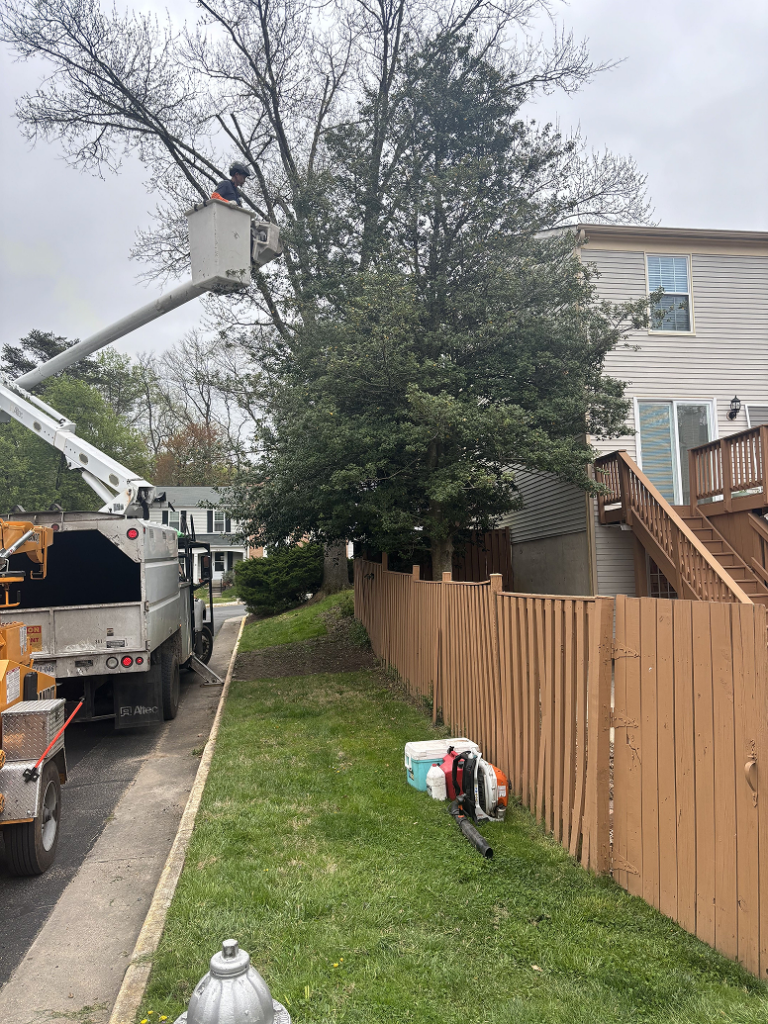
Emergency tree removal after a storm often means working in compromised conditions—fallen trees on structures, tight access, debris everywhere. A company equipped with the right equipment for these situations—not just a pickup truck and a chainsaw—will do the job faster, safer, and with less additional damage to your property. Ask whether they have aerial equipment, cranes, or the capacity to handle large-scale removals in confined spaces.
Local Knowledge and Utility Coordination
Manassas has a mix of overhead and underground utilities, and tree removal near power lines requires coordination with Dominion Energy or other utility providers. A company that works regularly in this area knows the local utility contacts, the underground service alert (MISS UTILITY) requirements for Virginia, and the workflow for getting work done safely near energized lines. This is not knowledge to assume—it’s knowledge to verify.
ISA Certification and Arboricultural Training
Emergency work is still tree work, and the same professional standards apply. An ISA Certified Arborist on staff or leading the crew means decisions about how to remove a tree—cut points, rigging, sequencing—are being made by someone with formal training, not just experience. In complex situations involving trees on structures or near other trees, that training matters.
References and Local Reputation
Ask neighbors, your HOA, or local Facebook and Nextdoor groups for recommendations. A tree service company that does good work in Manassas gets known for it—and so does one that doesn’t. A quick search for reviews, including how the company responds to criticism, tells you a lot about how they operate when things get complicated.
Pre-Storm Prep: What to Do Now
The best emergency response is the one you don’t need. Here’s a practical checklist for getting your Manassas property ready before May storms arrive.
Schedule a Pre-Season Tree Assessment
A qualified arborist can walk your property and flag trees or limbs that pose a risk. This is especially worth doing if you haven’t had a professional look at your trees in the last two to three years, if you have large trees close to your house, or if you’ve had major weather events recently that may have caused structural damage that isn’t yet visible.
Remove or Treat Deadwood
If a professional identifies dead limbs in your tree canopies, get them removed before storm season. This is relatively straightforward work when done under non-emergency conditions—faster, cheaper, and safer than dealing with the aftermath of a deadwood failure during a storm.
Consider Cabling and Bracing for At-Risk Trees
For trees with co-dominant stems or structurally weak junctions that are otherwise healthy and worth preserving, cabling and bracing can provide meaningful support. This is not a permanent fix for a tree that’s already failing, but for a sound tree with a specific structural vulnerability, it’s a legitimate and often cost-effective option.
Clean Up Existing Debris
Loose branches, old stumps, and debris piles around your yard become projectiles in high winds. A pre-season cleanup reduces the material available to cause damage during a storm.
Know Your Trees’ Root Zones
Avoid parking heavy vehicles or equipment near the root zones of large trees, especially after rain when the soil is soft. Compaction and mechanical root damage are cumulative stressors that weaken trees over time and increase failure risk.
Have a Plan and a Number Ready
Save the contact information for a trusted emergency tree removal company in Manassas before you need it. When a storm comes through at midnight, having a number ready—and knowing the company is legitimate and insured—is worth more than any amount of searching you’d do in the moment.
Frequently Asked Questions
Can I remove a storm-damaged tree myself? For small trees and shrubs, homeowners with the right equipment and experience can sometimes handle cleanup safely. For anything larger than a small ornamental, or any tree near a structure or utility line, professional removal is strongly recommended. Storm-damaged trees are structurally unpredictable—they can shift or fall in unexpected directions, and chainsaw injuries are disproportionately common among untrained operators working on storm cleanup.
Who is responsible when a neighbor’s tree falls on my property? In Virginia, each property owner is generally responsible for trees on their land. If your neighbor’s tree falls on your property, your homeowner’s insurance typically covers the damage to your structures. However, if the neighbor had been notified in writing that the tree was hazardous and they failed to act, liability may shift. Document everything and consult with your insurance agent and possibly an attorney if the situation is contested.
Do I need a permit for emergency tree removal in Prince William County? Prince William County has provisions for emergency removal when an active hazard exists. That said, HOA rules, proximity to road rights-of-way, and regulated environmental buffers can still impose additional requirements even in emergencies. A local tree service company familiar with Manassas-area regulations can guide you through this quickly.
How much does emergency tree removal cost in Manassas? Costs vary widely depending on tree size, location, accessibility, and whether the tree is on a structure. Emergency or after-hours work typically carries a premium. Getting a written estimate before work begins—even in an emergency—is always the right move. Be cautious of door-to-door solicitors appearing immediately after storms; this is a known pattern for fraudulent contractors in the Northern Virginia area after major weather events.
What should I do if a tree falls on power lines on my property? Call Dominion Energy at their emergency line—do not attempt to move the tree or approach the lines. Stay at least 30 feet away from any downed line. Tree removal near energized utility lines requires coordination with the utility company and, in many cases, can only be completed after the lines have been de-energized by the utility crew.
Don’t Wait for the Storm to Tell You There’s a Problem
Manassas gets real weather in May. The storms that come through Prince William County can be fast, intense, and indifferent to how nice your yard looks. The trees that fail—the ones that end up on roofs and across driveways—are almost always ones that had warning signs that went unaddressed.
Getting ahead of this doesn’t take a lot of time or money. A professional tree assessment, some targeted deadwood removal, and a clear plan for who to call in an emergency covers most of what you need. The peace of mind that comes with knowing your property is prepared is genuinely worth it.
Talk to United Tree Care Before the Next Storm Hits
United Tree Care provides emergency tree removal in Manassas VA and throughout Prince William County—along with pre-season inspections, hazard tree assessments, deadwood removal, and storm prep consultations for residential properties.
Our team knows Manassas. We know the soil conditions, the common tree species, the local permitting process, and what a storm-damaged property needs in the hours after a major weather event. We’re fully insured, and we’re available when it matters.Don’t wait until there’s a tree on your roof to find out who to call. Reach out to United Tree Care today to schedule a pre-season assessment or to talk through any concerns about the trees on your property. We’ll give you a clear, honest picture of where things stand—and what, if anything, needs to happen before storm season is in full swing.