Article Summary
- Many trees show clear warning signs well before they fail—knowing what to look for prevents emergencies
- Structural problems like cracks, hollow trunks, and co-dominant stems are serious red flags
- Root damage and soil changes around the base are often the earliest signs of a failing tree
- Dead wood, canopy dieback, and fungal growth all point toward a decline that may be irreversible
- Location matters—a damaged tree near your home carries far more risk than one in an open yard
- Not every problem tree needs to come down immediately, but all of them need professional evaluation
- Manassas homeowners face specific local factors—clay soils, storm activity, and dense canopy—that accelerate tree decline
Most trees don’t fail without warning. The signals are usually there—sometimes for months or even years before a branch comes through a roof or a root system finally gives up during a summer storm. The problem is that most homeowners don’t know what to look for, and a tree that looks perfectly fine from the kitchen window can be structurally compromised in ways that only become visible when you know where to look.
In Manassas, this matters more than it might in other places. The combination of mature residential tree canopy, frequent severe weather, and homes built on clay-heavy soils creates conditions where tree failures happen faster and hit harder than many homeowners anticipate. A tree that might limp along for another decade in ideal conditions can fail in a single storm season here.
This guide walks you through the warning signs that a tree may need to come down—from the obvious to the easy-to-miss—and helps you understand when a professional assessment is the right next step.
Why Trees Fail: The Short Version
Before getting into the specific signs, it helps to understand the general reasons trees reach the point of removal. Most tree failures fall into one of a few categories: structural defects that develop over time, disease or decay that compromises the wood internally, root system damage from construction or soil conditions, environmental stress from drought, flooding, or repeated storm damage, or simply age and decline in species that have reached the end of their natural lifespan in a given site.
In many cases, more than one of these factors is at work simultaneously. A tree weakened by a fungal infection becomes more vulnerable to wind loading. A tree with root damage from a driveway installation is more likely to uproot during a period of saturated soil. These compounding factors are one reason why professional arborist assessments are valuable—an untrained eye can see that a tree looks unhealthy without being able to identify the underlying cause or estimate how much time is left before failure becomes likely.
Structural Warning Signs: What to Look for on the Trunk and Main Branches
The trunk and primary branch structure of a tree are its load-bearing framework. Problems here are serious and often non-recoverable.
Deep Cracks or Splits in the Trunk
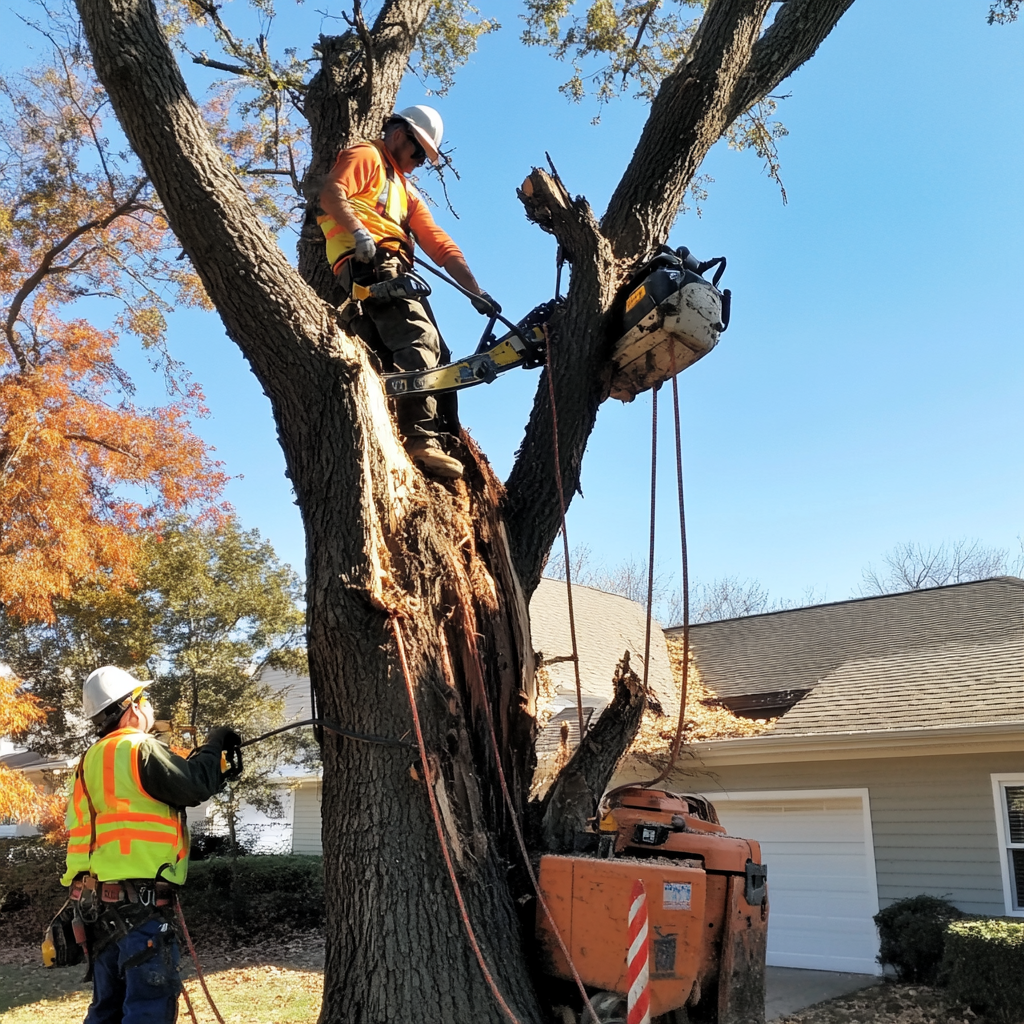
Vertical cracks running along the length of the trunk—particularly those that are deep enough to see into the interior of the tree—are one of the clearest structural warning signs. These cracks can develop from frost damage (a real consideration in Manassas winters), from lightning strikes, or from internal decay that has weakened the wood to the point where it separates under its own load.
A single hairline crack in a small branch is a different matter. A crack that runs several feet along the main trunk and shows evidence of opening and closing with temperature or moisture changes is a tree that deserves urgent professional attention.
Co-Dominant Stems With Included Bark
Co-dominant stems are two or more main trunks of roughly equal size growing from the same point on the tree. On their own, co-dominant stems aren’t necessarily a problem. The issue arises when the union between them includes “included bark”—bark that has been pushed inward between the stems rather than forming a solid wood connection.
Included bark unions are inherently weak. The two stems are essentially pushing against each other rather than growing together, and the connection between them will fail eventually. The question is when. In a tree growing in an open field away from structures, this might be a low-priority concern. In a tree whose co-dominant stems are leaning over your garage or your neighbor’s fence, it’s an urgent one.
Look at the crotch between the main stems. A healthy union is rounded and shows a collar of bark growth. An included bark union looks pinched, tight, and often shows a seam of bark pressed into the wood rather than a smooth junction.
Cankers and Sunken, Discolored Areas
A canker is a localized dead area on the bark or wood of a tree, often caused by fungal or bacterial infection. Cankers appear as sunken, discolored, or cracked patches on the trunk or major limbs, sometimes with oozing sap or clear demarcation between living and dead tissue.
A single small canker on a minor branch isn’t necessarily a tree-ending problem. Cankers that girdle—wrap around—a major branch or the main trunk are serious. Once a canker circles more than half the circumference of the stem, the structural and vascular integrity of that section is significantly compromised.
Wounds That Aren’t Healing
Trees respond to wounds—from pruning cuts, storm damage, or physical impact—by forming callus tissue that gradually rolls over the injured area. This process can take years, and that’s normal. What isn’t normal is a wound that shows no callus formation after several growing seasons, or a wound where the exposed wood has turned dark, soft, or punky.
Non-healing wounds are a signal that the tree’s vascular system in that area is compromised, and in many cases indicate internal decay that isn’t visible from the outside.
Signs of Internal Decay: What’s Happening Inside the Tree
Internal decay is one of the most insidious tree problems because it can be well advanced before external symptoms become obvious. A tree can look full and green on the outside while the heartwood at its center has rotted to the point of near-structural failure.
Fungal Growth at the Base or on the Trunk
Mushrooms, conks, or shelf fungi growing from the base of a tree or directly on the trunk are among the clearest external indicators of internal wood decay. These fruiting bodies are produced by fungi that have been breaking down the wood tissue from the inside, often for years before the fruiting bodies appear.
The presence of fungal growth doesn’t automatically mean a tree must come down immediately—the type of fungus, its location, and how much of the tree’s cross-section is affected all influence the risk assessment. But any tree showing fungal growth at the base or on the main trunk should be evaluated by an ISA-certified arborist promptly. This is not a wait-and-see situation.
In the Manassas area, species like white oak, silver maple, and tulip poplar—all common in residential neighborhoods here—are susceptible to root and butt rot fungi that can cause catastrophic structural failure with limited external warning.
Hollow Sections or Soft Wood
If you can knock on the trunk of a tree and hear a hollow sound, or if probing a wound reveals soft, crumbling wood rather than solid heartwood, internal decay is present. The degree to which this matters structurally depends on how much of the cross-section remains sound—arborists use a rough rule of thumb that a tree with more than one-third of its cross-section hollow or decayed has lost structural integrity that removal should be considered.
Hollow trees aren’t always immediate emergencies. Some hollow trees stand safely for years. But the margin for error during a storm or wind event shrinks significantly, and a tree that might handle a calm summer becomes a real risk when a derecho pushes through Northern Virginia with 70-mile-per-hour winds.
Unusual Softness After Probing
On older trees, homeowners sometimes notice areas of the bark that feel soft or spongy when pressed, or spots where the bark separates from the underlying wood more easily than it should. This can indicate wet wood decay, sap-staining fungi, or bacterial wetwood—all signs that the wood beneath the bark is not structurally sound.
Root and Base Warning Signs: The Foundation Nobody Thinks About
Root problems are the most commonly overlooked category of tree hazards because roots are largely invisible. But the base of the tree and the soil immediately around it tell a meaningful story if you know what to look at.
Heaving or Cracked Soil Around the Base
When a tree’s root plate begins to fail—either from root decay, from physical damage, or from soil saturation that reduces friction—the first visible sign is often heaving or cracking in the soil on the opposite side of the lean. The root plate essentially acts as a lever: as the tree shifts under wind load, the upwind side of the root plate lifts, and the soil there begins to crack and raise.
In Manassas’s clay soils, this heaving can be subtle and easy to miss if you’re not looking for it. After a major storm, walk around the base of your large trees and look specifically at the soil 4 to 8 feet from the trunk in all directions. Any raised, cracked, or disturbed soil pattern that wasn’t there before the storm is a warning sign.
Exposed Roots That Show Damage or Decay
Surface roots that are cracked, soft, discolored, or showing signs of fungal activity are doing the same thing underground on the roots you can’t see. Healthy surface roots should be firm and show live wood when nicked. Roots that crumble, are discolored brown or black through their cross-section, or that have soft, wet wood inside have lost both structural and vascular function.
Pay particular attention to the large buttress roots that flare from the base of the trunk. These are the primary anchor points, and decay in the buttress root zone directly reduces the tree’s ability to stay upright under load.
Soil Subsidence or Sinking Near the Base
As large root systems decay underground, the soil above them slowly settles. A circular or irregular area of subsided soil around the base of a tree—particularly in a tree that has been showing other stress symptoms—can indicate that the root system is no longer structurally intact underground even though the tree appears stable above ground.
This is particularly relevant for older trees in the established neighborhoods around Old Town Manassas and the historic core of the city, where large trees have been growing in the same soil for 50, 60, or more years.
Girdling Roots
Girdling roots grow in a circular pattern around the base of the trunk rather than radiating outward, eventually compressing the trunk’s vascular tissue and strangling the tree over time. They’re most visible as roots that wrap visibly around the trunk at or below the soil line, sometimes creating a visible constriction in the lower trunk.
Left unaddressed, girdling roots contribute to a gradual decline—reduced crown density, premature fall color, dieback—and can eventually cause the tree to fail at the root collar under wind loading.
Canopy Warning Signs: What the Top of the Tree Is Telling You
The crown of the tree—its leaves, small branches, and overall canopy structure—is where many internal and root problems first show up as visible symptoms.
Dieback in the Upper Crown
Progressive dieback—where branches in the upper canopy die off while the lower portions of the tree remain green—is a symptom the arborist community takes seriously. It can indicate root decline (the root system can no longer support the full canopy), vascular disease (movement of water and nutrients is being blocked), or severe pest pressure.
In Northern Virginia, the hemlock woolly adelgid has devastated eastern hemlock populations over the past two decades. Emerald ash borer has eliminated most ash trees from the regional canopy. Bacterial leaf scorch and thousand cankers disease affect oaks and walnuts respectively. These diseases and pests don’t always kill trees quickly—they cause progressive decline that plays out over several growing seasons, with upper crown dieback often appearing well before the tree is fully dead.
Dead Branches Throughout the Canopy
Some dead branches in a mature tree are normal—interior shading naturally causes branch die-off over time. The concern is when dead branches are distributed throughout the canopy at multiple levels, particularly when they’re large-diameter wood rather than small interior twigs.
Large dead branches—anything over 3 to 4 inches in diameter—are called “widow makers” for a reason. They can drop without warning at any time, and they don’t need a storm to do it. Heat, drought, vibration, and simple gravity are enough to bring down dead wood that’s been hanging in a tree canopy for a season or two.
A professional pruning to remove dead wood can sometimes extend the useful life of a declining tree significantly, but that assessment requires someone qualified to evaluate how much of the canopy is affected and whether the underlying cause is recoverable.
Abnormal Leaf Size, Color, or Timing
Leaves that are smaller than normal for the species, off-color through the growing season (chlorotic yellow or pale green when they should be dark), or that drop prematurely in late summer when the rest of the neighborhood trees are still green—these are all signs of a tree under significant stress.
Chlorosis—yellowing between the leaf veins—in particular can indicate a range of problems, from iron or manganese deficiency in Manassas’s alkaline clay soils to vascular disease that prevents the tree from moving nutrients through its system.
A single season of abnormal leaf appearance doesn’t necessarily mean removal is imminent. A pattern of declining leaf quality across two or three consecutive growing seasons points toward a tree that is in progressive decline and unlikely to recover without intervention—or at all.
Sparse Canopy That Gets Sparser Each Year
A gradual thinning of the canopy over successive growing seasons—fewer leaves, shorter shoot extension, smaller overall crown—is one of the slower-moving but reliable signs of a tree in structural and vascular decline. Compare photos from year to year if you have them. A tree that was dense and full three or four years ago but has progressively thinned is telling you something meaningful.
Location and Risk: Why the Same Problem Means Different Things in Different Spots
One of the most important factors in the tree removal decision isn’t the tree’s condition in isolation—it’s the relationship between the tree’s condition and what’s beneath and around it.
Target Zone Assessment
Arborists use the term “target” to describe what’s in the fall zone of a potentially hazardous tree. A tree with significant decay, leaning over your home, your child’s play area, or a frequently used driveway has a very different risk profile than the same tree leaning over an open fence line or into a wooded area.
When evaluating whether a tree needs to come down, factor in: How many hours per day do people or vehicles occupy the potential fall zone? What is the value and replaceability of what’s in that zone? How far away are the nearest occupied structures? These questions shift the urgency calculation significantly.
Trees Near the Foundation
Large trees growing close to the home’s foundation create two distinct risk categories. The first is the obvious structural risk if the tree falls toward the house. The second is the slow-moving root impact on the foundation itself—large root systems can exert pressure on foundation walls, invade drainage systems, and disrupt underground utilities over time.
In Manassas’s older neighborhoods—particularly the blocks around the historic core and pre-war residential streets—this is a real and recurring issue. Trees that were planted close to homes 40 or 50 years ago when they were small ornamentals are now large trees with root systems that have grown into and around infrastructure in ways that weren’t anticipated.
Trees Over Utility Lines and Infrastructure
A tree that is in progressive decline but located over a power line, over a buried gas main, or straddling a property line creates a complexity that a straightforward yard tree doesn’t. Dominion Energy Virginia manages vegetation near transmission and distribution lines through their own programs, but distribution lines running through residential tree canopy are often addressed reactively rather than proactively. If you have a declining tree near utility lines on your property, proactive removal before the tree fails is almost always less complicated and less costly than emergency removal after contact.
When a Tree Can Be Saved vs. When It Needs to Come Down
Not every problem tree is automatically a removal candidate. A professional arborist evaluation can determine which situations are recoverable and which aren’t.
Situations That May Be Recoverable
A tree with a single significant dead branch that can be pruned, with an otherwise healthy crown and sound root system, may have a long useful life ahead with proper care. A tree with early-stage fungal infection confined to a specific area, caught before it spreads to the structural wood, may respond to treatment. A tree showing signs of drought or nutrient stress that can be addressed with irrigation and soil amendment may fully recover.
Cable bracing and support systems can extend the life of trees with co-dominant stems or structural weaknesses in some cases—though this requires professional installation and ongoing monitoring.
Situations That Almost Always Lead to Removal
A tree with advanced decay in the root collar or main trunk, where more than one-third of the cross-section is compromised. A tree that has lost more than 50 percent of its root system to construction damage, disease, or physical removal. A tree with active, fast-spreading vascular disease—Dutch elm disease, oak wilt, or advanced bacterial leaf scorch—where the disease cannot be contained. A tree that is dead or nearly dead throughout the canopy with no evidence of recovery growth. A tree that has already partially failed and whose remaining structure is unlikely to support continued standing.
The distinction between these categories is exactly why a professional evaluation matters. The homeowner’s eye can identify that something is wrong with a tree, but determining whether that something is recoverable or not requires training, equipment, and experience.
The Manassas-Specific Factors That Accelerate Tree Decline
A few local conditions worth naming explicitly, because they affect the timeline for tree problems in ways that are specific to this area.
Clay soil compaction. Manassas’s clay-heavy soils compact readily under foot traffic, vehicle pressure, and construction activity. Compacted soil restricts oxygen to roots and reduces the tree’s ability to take up water—a slow stressor that contributes to gradual decline, particularly in older trees in developed areas.
Storm cycles. The frequency of severe thunderstorms, occasional derechos, and nor’easters in this part of Northern Virginia means that structurally compromised trees face significant wind loading multiple times per year. A tree that might stand for another decade in a calmer climate may fail in the first significant weather event after its structural integrity begins to decline.
Construction and development proximity. The Manassas area has seen significant residential and commercial development over the past several decades. Trees in established neighborhoods often have root systems that have been disturbed by nearby construction—utility trenching, grading, foundation work—without the homeowner or the current property owner being aware of it. This root damage can show up as canopy decline years after the construction activity that caused it.
Pest and disease pressure. The regional pest landscape—emerald ash borer, hemlock woolly adelgid, spotted lanternfly, and bacterial disease complexes—creates ongoing pressure on tree health that is more acute in Northern Virginia than in many parts of the country. Trees that are already stressed by other factors are more susceptible to secondary pest infestations.
What to Do If You Think Your Tree May Need to Come Down
If you’ve read through this guide and one or more of the warning signs applies to a tree on your Manassas property, the right first step is a professional assessment—not a decision made from the driveway.
An ISA-certified arborist can evaluate the tree up close, probe for decay, assess root condition, identify disease or pest pressure, and give you a clear picture of the tree’s actual structural condition. That assessment might result in a recommendation for removal, or it might result in a treatment plan, a pruning prescription, or a monitoring schedule that gives the tree more time while managing the risk.
What it won’t do is leave you guessing.
Trust United Tree Care to Give You a Straight Answer
When a tree on your Manassas property is showing warning signs, you deserve a clear, honest assessment from someone who knows what they’re looking at—not a sales pitch, not a scare tactic, and not a guess.
United Tree Care serves homeowners throughout Manassas and the surrounding Northern Virginia area with professional tree assessments, removal, pruning, and tree care services. The team includes ISA-certified arborists who know the local tree species, the local soil conditions, and the storm patterns that affect this region—and they’ll tell you plainly what a tree needs, whether that’s removal, treatment, or simply monitoring.
If you have a tree you’re concerned about, reach out to United Tree Care to schedule an evaluation. Getting a professional set of eyes on it is the most practical thing you can do to protect your property and your family—before a warning sign becomes an emergency.