
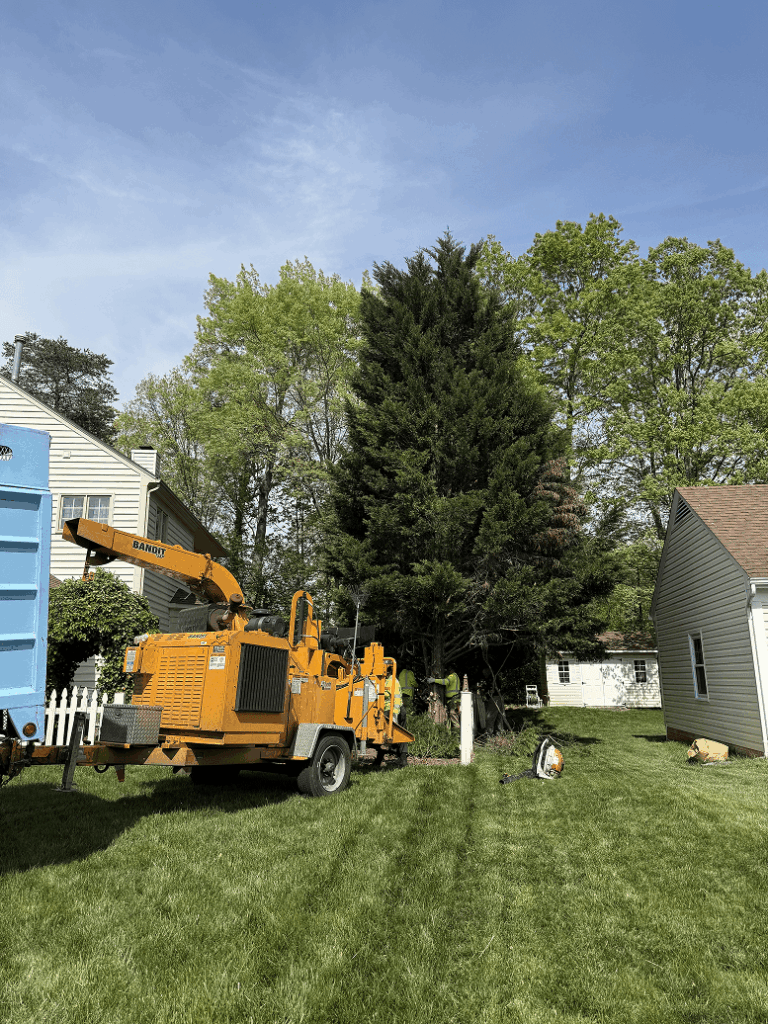
Understanding proper tree trimming techniques can help Manassas homeowners make informed decisions about their tree care needs. While major tree work requires professional expertise, knowing the science behind proper pruning methods helps property owners recognize quality work and communicate effectively with arborists about their goals.
Professional tree trimming involves much more than simply cutting branches. Scientific pruning techniques consider tree biology, growth patterns, and species-specific needs to promote long-term health while achieving aesthetic and safety objectives. These methods, developed through decades of research and field experience, form the foundation of modern arboriculture.
This guide explores the professional techniques used by certified arborists to maintain healthy, attractive trees throughout Manassas and Prince William County. From understanding basic cuts to recognizing advanced structural pruning methods, you’ll gain insight into the skilled practices that keep trees thriving in Northern Virginia’s unique climate.
Fundamental Pruning Cuts and Their Applications
The Three-Cut Method for Large Branches
Professional arborists use the three-cut technique to remove large branches safely without damaging tree bark or creating entry points for diseases. This method prevents bark stripping that occurs when heavy branches tear away from the trunk during removal.
The first cut, made from underneath the branch about 12-18 inches from the trunk, extends approximately one-third through the branch diameter. This undercut prevents bark from stripping down the trunk when the branch falls during the second cut.
The second cut begins from the top of the branch, positioned slightly further from the trunk than the undercut. This cut removes the majority of the branch weight, allowing it to fall cleanly without damaging the remaining stub or trunk bark.
The final cut removes the remaining stub by cutting just outside the branch collar – the swollen area where the branch meets the trunk. This precise placement allows the tree to seal the wound naturally using its own defense mechanisms, preventing decay and disease entry.
Proper Cut Placement and Branch Collar Recognition
The branch collar contains specialized cells that compartmentalize wounds and prevent decay from spreading into the trunk. Professional arborists learn to identify these collars on different tree species, as they vary in size and appearance between species and individual trees.
Flush cuts that remove the branch collar prevent proper wound sealing and create larger wounds that are difficult for trees to close. These cuts, once considered proper technique, are now recognized as harmful practices that increase disease susceptibility and reduce tree longevity.
Stub cuts that leave excessive branch material beyond the collar also interfere with natural healing processes. These stubs often die back and become entry points for insects and diseases that can spread into healthy trunk tissue.
Angle cuts follow the natural angle of the branch collar, typically sloping slightly away from the trunk. This angle varies between species and branch positions, requiring arborists to assess each cut individually rather than applying uniform techniques.
Thinning vs. Heading Cuts
Thinning cuts remove entire branches back to their point of origin, maintaining natural growth patterns while reducing density. These cuts are preferred for most mature tree pruning because they preserve the tree’s natural form and growth habits.
Heading cuts shorten branches by cutting back to lateral branches or buds, stimulating dense growth behind the cut. While useful for specific applications like developing young tree structure, heading cuts can create maintenance problems if overused on mature trees.
Professional arborists use thinning cuts to open canopies for better air circulation and light penetration while maintaining natural branch spacing. This technique reduces wind resistance and storm damage potential without stimulating excessive regrowth.
Heading cuts find appropriate use in crown reduction when thinning alone cannot achieve necessary size reduction. However, these cuts require careful selection of lateral branches strong enough to assume terminal roles without developing weak growth patterns.
Crown Cleaning and Maintenance Techniques
Dead, Diseased, and Damaged Branch Removal
Crown cleaning forms the foundation of professional tree maintenance, focusing on removing branches that compromise tree health or safety. This technique requires careful assessment to distinguish between healthy and problematic branches throughout the canopy.
Dead branch identification involves recognizing bark characteristics, brittleness, and lack of seasonal responses like budding or leaf development. Professional arborists learn species-specific indicators that help identify dead wood that may not be obviously lifeless to untrained observers.
Diseased branch removal requires understanding common tree diseases in Manassas and their typical progression patterns. Arborists remove infected branches with sufficient healthy tissue to prevent disease spread while minimizing removal of unaffected wood.
Damaged branches from storms, construction, or other impacts need prompt attention to prevent secondary problems. Professional assessment determines whether damaged branches can be preserved through proper pruning or require complete removal to maintain tree health.
Crossing and Rubbing Branch Management
Branches that cross or rub against each other create wounds that invite insect and disease problems. Professional crown cleaning identifies these conflicts early and removes the less desirable branch to prevent ongoing damage.
Selection of which branch to remove depends on multiple factors including size, position, growth potential, and contribution to overall tree structure. Arborists consider long-term growth patterns when making these decisions rather than simply removing the smaller branch.
Temporary conflicts between young branches may resolve naturally as trees mature and branch angles change. Experienced arborists distinguish between temporary situations and permanent problems that require intervention.
Preventive removal of crossing branches during routine maintenance prevents larger problems that would require more extensive pruning later. This proactive approach maintains tree health while minimizing the amount of live wood that must be removed.
Water Sprout and Sucker Removal
Water sprouts grow rapidly from trunk or main branch surfaces, often in response to stress, pruning, or environmental changes. These shoots grow faster than normal branches and develop weak attachments that make them prone to failure.
Professional removal of water sprouts involves cutting them flush with the bark surface without leaving stubs that encourage regrowth. Sharp, clean cuts heal more quickly and are less likely to stimulate additional sprout development.
Root suckers that emerge from tree bases or surface roots compete with the main tree for nutrients and water while creating cluttered appearances. Regular removal prevents these shoots from developing into competing trunks that weaken overall tree structure.
Timing of water sprout removal affects regrowth potential. Multiple removal sessions during the growing season can exhaust the tree’s energy reserves for producing new sprouts, providing better long-term control than single annual removals.
Structural Pruning for Young Trees
Central Leader Development
Young tree training focuses on establishing strong central leaders that will support mature canopies throughout the tree’s lifetime. This technique is particularly important for species that naturally develop single dominant trunks like oaks, maples, and many evergreens.
Competing leaders create weak attachment points and unbalanced canopies that are prone to storm damage. Early identification and removal of secondary leaders prevents codominant stem development that compromises long-term structural integrity.
Professional arborists use temporary stakes or ties to encourage proper leader development when trees show tendencies toward multiple trunks. These supports help train young trees into desired forms while their wood is still flexible and responsive.
Species-specific leader training recognizes that some trees naturally develop multiple trunks or open growth habits. Arborists adapt their techniques to work with natural growth patterns rather than forcing inappropriate forms on individual species.
Scaffold Branch Selection and Spacing
Scaffold branches form the permanent framework of mature tree canopies. Professional structural pruning selects and develops these branches during the tree’s early years when modifications are easiest and least stressful.
Proper scaffold spacing prevents branches from competing for the same growing space and reduces future conflicts. Vertical spacing of 12-24 inches between scaffold branches provides room for development without overcrowding as trees mature.
Radial distribution of scaffold branches around the trunk creates balanced canopies that resist wind damage. Professional selection avoids clustering branches on one side of the tree that could create unbalanced weight distribution.
Branch angles affect attachment strength and long-term stability. Branches growing at 45-60 degree angles from the trunk develop stronger attachments than those growing at steep or shallow angles that are prone to failure.
Early Corrective Pruning
Minor structural problems are easily corrected in young trees through selective pruning that guides growth into desired patterns. Early intervention prevents problems that would require major corrective work or tree removal later.
Included bark develops where branches grow too closely together, creating weak attachment points. Professional pruning widens branch angles or removes competing branches before included bark becomes a structural problem.
Branch defects like kinks, sharp turns, or damaged areas can often be corrected through selective pruning that redirects growth through lateral branches. This technique preserves branch structure while eliminating weak points.
Growth habit modification through young tree pruning can improve species that naturally develop problematic structures. Professional techniques work with natural growth patterns while guiding development toward stronger, more attractive forms.
Crown Reduction and Size Management
Proper Crown Reduction Techniques
Crown reduction reduces overall tree size while maintaining natural form and growth patterns. This advanced technique requires extensive knowledge of tree biology and species-specific growth habits to avoid creating problems worse than the original size concerns.
Drop-crotching involves cutting back to lateral branches large enough to assume terminal roles without developing weak growth patterns. These lateral branches should be at least one-third the diameter of the removed branch to handle the increased growth responsibilities.
Professional crown reduction maintains the tree’s natural taper from trunk to branch tips. Uniform cutting across the canopy creates unnatural appearances and stimulates dense regrowth that requires frequent maintenance.
Species tolerance for crown reduction varies significantly, with some trees like maples tolerating moderate reduction while others like oaks respond poorly to significant size reduction. Professional arborists understand these differences and adjust techniques accordingly.
Alternatives to Topping
Topping – the indiscriminate cutting of tree tops – is never appropriate and causes numerous problems including weak regrowth, increased maintenance needs, and reduced tree lifespan. Professional arborists use alternative techniques that achieve size reduction goals without damaging trees.
Selective thinning reduces canopy density and wind resistance without dramatically altering tree size. This technique removes entire branches back to their origins, maintaining natural growth patterns while addressing storm damage concerns.
Crown raising removes lower branches to provide clearance for vehicles, pedestrians, or structures. This approach maintains overall tree size while solving access problems that might otherwise lead to inappropriate topping.
Crown cleaning combined with selective thinning often addresses homeowner concerns about tree size by improving light penetration and reducing perceived density without harmful size reduction cuts.
Restoration Pruning for Damaged Trees
Previously topped trees require specialized restoration techniques to reestablish natural growth patterns and structural integrity. This process takes several years and may not completely restore the tree’s original form and strength.
Restoration begins with selecting the best-positioned sprouts from topping cuts and removing competing growth. These selected shoots gradually develop into replacement branches, though they will never be as strong as original branches.
Professional restoration pruning spreads the work over multiple years to avoid additional stress on already-compromised trees. Annual sessions gradually improve structure while allowing trees to rebuild energy reserves between pruning sessions.
Some severely damaged trees cannot be successfully restored and may require removal for safety reasons. Professional assessment determines whether restoration is feasible or if replacement represents a better long-term solution.
Species-Specific Pruning Approaches
Oak Tree Pruning Techniques
Oak trees in Manassas require specialized timing and techniques to prevent oak wilt disease transmission. Professional oak pruning occurs only during dormant seasons when disease-carrying beetles are inactive.
Oak structure naturally develops strong central leaders with well-spaced scaffold branches. Professional pruning works with these natural patterns rather than forcing oaks into unnatural forms that increase stress and disease susceptibility.
Mature oaks tolerate minimal pruning and respond poorly to crown reduction or heavy thinning. Professional maintenance focuses on crown cleaning and selective removal of problematic branches while preserving the tree’s natural form.
Young oak training emphasizes developing strong scaffold branches and maintaining single leaders. Early structural pruning prevents problems that would be difficult to correct in mature specimens without significant tree stress.
Maple Tree Maintenance
Maple trees have different pruning requirements based on their species, with sugar maples needing more conservative approaches than fast-growing silver maples. Professional arborists adjust techniques based on specific maple varieties and their growth characteristics.
Maple bleeding during spring pruning is normal and does not harm trees, though it may be aesthetically undesirable. Professional scheduling often avoids late winter and early spring when sap flow is heaviest.
Structural problems like codominant stems are common in maples and require early intervention to prevent failure. Professional pruning can correct these problems in young trees but may require cabling or removal in mature specimens.
Maple species vary in their tolerance for crown reduction, with some handling moderate reduction while others develop extensive water sprout growth. Professional techniques account for these species differences when planning pruning approaches.
Pine and Evergreen Pruning
Evergreen pruning requires understanding of species-specific growth patterns and timing requirements. Most evergreens cannot regrow from old wood, making proper technique and timing critical for maintaining attractive appearances.
Pine candle pruning in late spring removes new growth shoots to control size and increase density. This technique requires precise timing when new growth is soft but before needles fully develop.
Spruce and fir trees respond well to light thinning and crown cleaning but tolerate crown reduction poorly. Professional maintenance focuses on maintaining natural forms while addressing specific problems like dead or damaged branches.
Juniper and arborvitae can tolerate more aggressive pruning than pine species but still require careful technique to avoid creating bare areas that will not regenerate. Professional shaping maintains dense growth while achieving desired forms.
Timing and Seasonal Considerations
Dormant Season Pruning Advantages
Winter pruning during dormancy provides multiple advantages including reduced stress on trees, improved visibility of branch structure, and minimized disease transmission risks. Most professional tree pruning in Manassas occurs during December through February.
Dormant trees allocate energy reserves toward healing pruning wounds rather than supporting active growth. This energy allocation promotes faster wound closure and reduces the likelihood of secondary problems from pruning stress.
Branch structure assessment is easier during dormancy when leaves don’t obscure branching patterns. Professional arborists can better evaluate structural problems and make precise cuts that promote long-term tree health.
Reduced disease pressure during winter months minimizes infection risks from pruning wounds. Most tree pathogens are inactive during cold weather, making dormant season pruning safer for tree health.
Species-Specific Timing Requirements
Spring-flowering trees like dogwoods, redbuds, and cherry trees require post-bloom pruning to avoid removing flower buds that form the previous year. Professional timing preserves flowering while maintaining tree health and structure.
Oak wilt prevention requires strict dormant season pruning for all oak species. Professional services schedule oak work only during winter months when disease-transmitting beetles are inactive.
Maple syrup trees should be pruned after sap flow stops to minimize bleeding, though this aesthetic concern doesn’t harm tree health. Professional scheduling can accommodate homeowner preferences while maintaining proper timing for tree health.
Evergreen species have varying requirements, with pine candle pruning requiring late spring timing while most other evergreen maintenance occurs during dormancy.
Weather-Related Scheduling Considerations
Extreme weather conditions affect pruning scheduling and techniques. Professional services monitor weather forecasts and adjust schedules to maintain worker safety while completing necessary tree care.
Frozen wood is more brittle and prone to splitting during pruning operations. Professional arborists may delay work during extreme cold periods to prevent damage from brittle wood behavior.
Wet conditions create safety hazards and can prevent equipment access to trees. Professional companies reschedule work when necessary to maintain safety standards and prevent property damage from heavy equipment.
Storm damage creates urgent pruning needs that may require work outside ideal timing windows. Professional emergency services focus on safety hazards while minimizing cuts that might compromise tree health when performed during suboptimal timing.
Tools and Equipment for Professional Results
Hand Tool Selection and Maintenance
Professional pruning requires sharp, properly maintained tools that make clean cuts promoting rapid healing. Dull tools create ragged wounds that heal slowly and provide entry points for diseases and insects.
Bypass pruners work best for most small branch cutting applications, creating clean cuts that compress wood fibers minimally. Anvil-type pruners crush wood fibers and are generally inappropriate for live wood cutting.
Pruning saws with curved blades and aggressive tooth patterns cut efficiently through larger branches. Professional arborists maintain multiple saw types for different cutting applications and keep blades sharp for optimal performance.
Pole saws extend reach for higher branches but require skill to control accurately. Professional use involves understanding leverage principles and maintaining control during cutting operations to prevent accidents and property damage.
Power Tool Applications
Chain saws provide efficient cutting power for large branches and tree removal operations. Professional use requires extensive safety training and understanding of chain saw behavior under different cutting conditions.
Pole pruners with power heads allow efficient cutting of higher branches without climbing. Professional operators understand the limitations and safety requirements for this equipment type.
Hydraulic tools provide precise cutting power for large branches in confined spaces. Professional tree services invest in specialized hydraulic equipment for situations where conventional tools cannot provide adequate control.
Tool maintenance programs keep professional equipment operating safely and efficiently. Regular sharpening, cleaning, and inspection prevent equipment failures that could cause accidents or produce poor-quality cuts.
Safety Equipment and Practices
Personal protective equipment for professional tree work includes hard hats, safety glasses, hearing protection, and chainsaw protective clothing. Professional arborists use equipment rated for tree care applications.
Climbing equipment for aerial tree work requires specialized training and certification. Professional arborists maintain climbing gear according to manufacturer specifications and industry safety standards.
Ground protection equipment prevents property damage during tree work. Professional services use mats, tarps, and barriers to protect lawns, driveways, and landscaping during pruning operations.
Emergency equipment including first aid supplies and communication devices should be available during all tree work. Professional companies maintain safety protocols and emergency response procedures for accident situations.
Recognizing When to Call Professionals
Safety-Related Situations
Trees near power lines require professional attention regardless of the work needed. Utility line proximity creates electrocution hazards that require specialized training and equipment to manage safely.
Large branch removal above structures or valuable landscaping exceeds most homeowner capabilities. Professional rigging techniques allow controlled lowering of heavy branches without property damage.
Trees showing signs of structural instability need professional assessment before any pruning work begins. Unstable trees can fail unexpectedly during pruning operations, creating serious safety hazards.
Heights above comfortable ladder reach require professional climbing or aerial lift equipment. Most tree work above 10-12 feet should be performed by trained professionals with proper equipment.
Complex Technical Requirements
Crown reduction and structural correction require extensive knowledge of tree biology and species-specific growth responses. Improper techniques can permanently damage trees or create ongoing maintenance problems.
Disease diagnosis and treatment often accompany pruning operations. Professional arborists can identify disease problems and integrate treatment with pruning operations for optimal results.
Species identification affects pruning timing and techniques. Professional knowledge prevents mistakes that could harm trees or reduce their ornamental value.
Permit requirements for certain tree work in Manassas may require professional involvement. Some pruning operations require permits that are more easily obtained by licensed professionals.
Long-term Tree Health Considerations
Young tree training establishes growth patterns that last throughout the tree’s lifetime. Professional structural pruning during early years prevents problems that would be expensive to correct later.
Mature tree maintenance requires understanding of species longevity and decline patterns. Professional assessment helps determine appropriate maintenance levels for trees in different life stages.
Property value considerations may justify professional services even for work homeowners could perform themselves. Professional maintenance demonstrates quality property care that protects real estate investments.
Insurance and liability concerns favor professional services for most significant tree work. Professional companies carry insurance that protects property owners from accident-related claims.
United Tree Care: Professional Techniques, Proven Results
At United Tree Care, we apply scientifically-based pruning techniques developed through decades of arboricultural research and field experience. Our ISA Certified Arborists understand tree biology and species-specific requirements that ensure pruning operations promote long-term health and structural integrity.
We use professional-grade equipment maintained to the highest standards for safety and cutting quality. Our tools receive regular maintenance and replacement schedules that guarantee clean cuts promoting rapid wound healing and reduced disease susceptibility.
Our comprehensive pruning services include:
- Crown cleaning and dead wood removal
- Structural pruning for young tree development
- Crown thinning and density reduction
- Size management through proper crown reduction
- Species-specific pruning timing and techniques
- Storm damage assessment and corrective pruning
- Utility line clearance pruning
- Restoration pruning for previously damaged trees
Every pruning project begins with detailed assessment by our certified arborists who evaluate tree health, structural integrity, and specific maintenance needs. We explain our recommendations and work with homeowners to develop pruning plans that achieve their goals while promoting optimal tree health.
Our team understands Prince William County’s diverse tree population and applies appropriate techniques for each species’ unique requirements. From native oaks requiring careful dormant season maintenance to ornamental species needing post-bloom pruning, we adjust our methods to match each tree’s needs.
We maintain current knowledge of industry best practices through continuing education and professional development programs. Our arborists stay updated on the latest research and techniques that improve pruning results and tree health outcomes.
Professional tree care represents an investment in your property’s long-term health and value. Contact United Tree Care today at (571) 604-6001 to schedule your consultation with our certified arborists and discover how proper pruning techniques can enhance your Manassas landscape.


